A Photographer’s Guide to Printing An Annual Photo Book
Consider this a companion piece to my how-to on scanning old photos – here’s how I make my annual photo album for the family, our vacations, and our kids.
Consider this a companion piece to my how-to on scanning old photos – here’s how I make my annual photo album for the family, our vacations, and our kids.
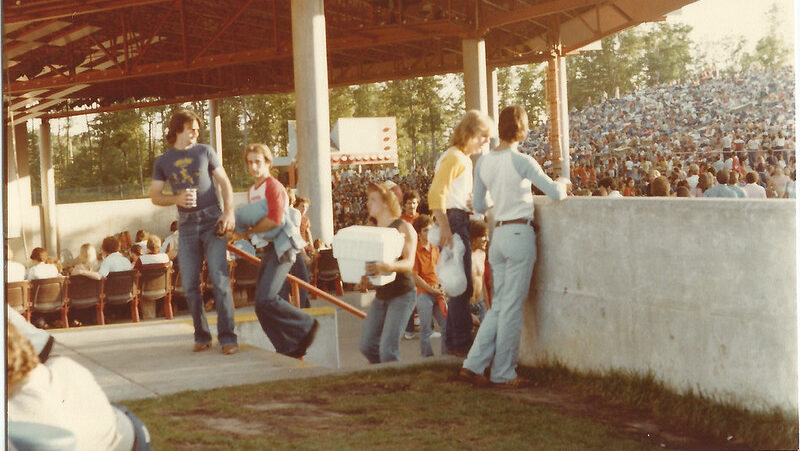
For people of a certain age (elder Millennial here), we grew up on the edge of film photography and digital photography. We witnessed the transition unfold firsthand. Our childhoods were captured on film, while our 20s and 30s were mobile and digital.
It’s kind of like when our grandparents’ celebrities – Bob Hope, for example – were still alive when we were kids, but maybe a little past their prime. We knew of them, understood their importance, but weren’t emotional when they passed.
We saw it all come and go, and we had to make the transition from one phase to another. Print photos were still a big thing until about 20 years ago. And now, with film photography making a comeback, it’s like we (and the folks a little older and younger than us) are rediscovering physical photos.

Take family photo albums. They’re like heirlooms. Chances are, people around my age were blessed with thick, ring-bound family albums. If we’re lucky, we still have them.
I had a treasured set of photo albums that I recovered after my mother passed away. But, my brain asks, what if something happens to those albums? What if they get wet? Or lost?
That’s why, a few years back, I made it a project to scan all my childhood photos for safekeeping. If something ever happened to the actual physical photos, I made sure to have a backup.

And now, I’m backing up that backup to Flickr – in a semi-private album. I pay for a Flickr Pro membership, which gives me unlimited uploads. If my backup drives were trashed, I have an off-site system to keep those photos safe.

How do I create the scanned backup?
There are lots of ways to do this. My method takes some time and patience, but I have control over the whole process, front to back.
So while I still live in both worlds – print and digital – I found a process that uses both types of media to keep my family photos secure.
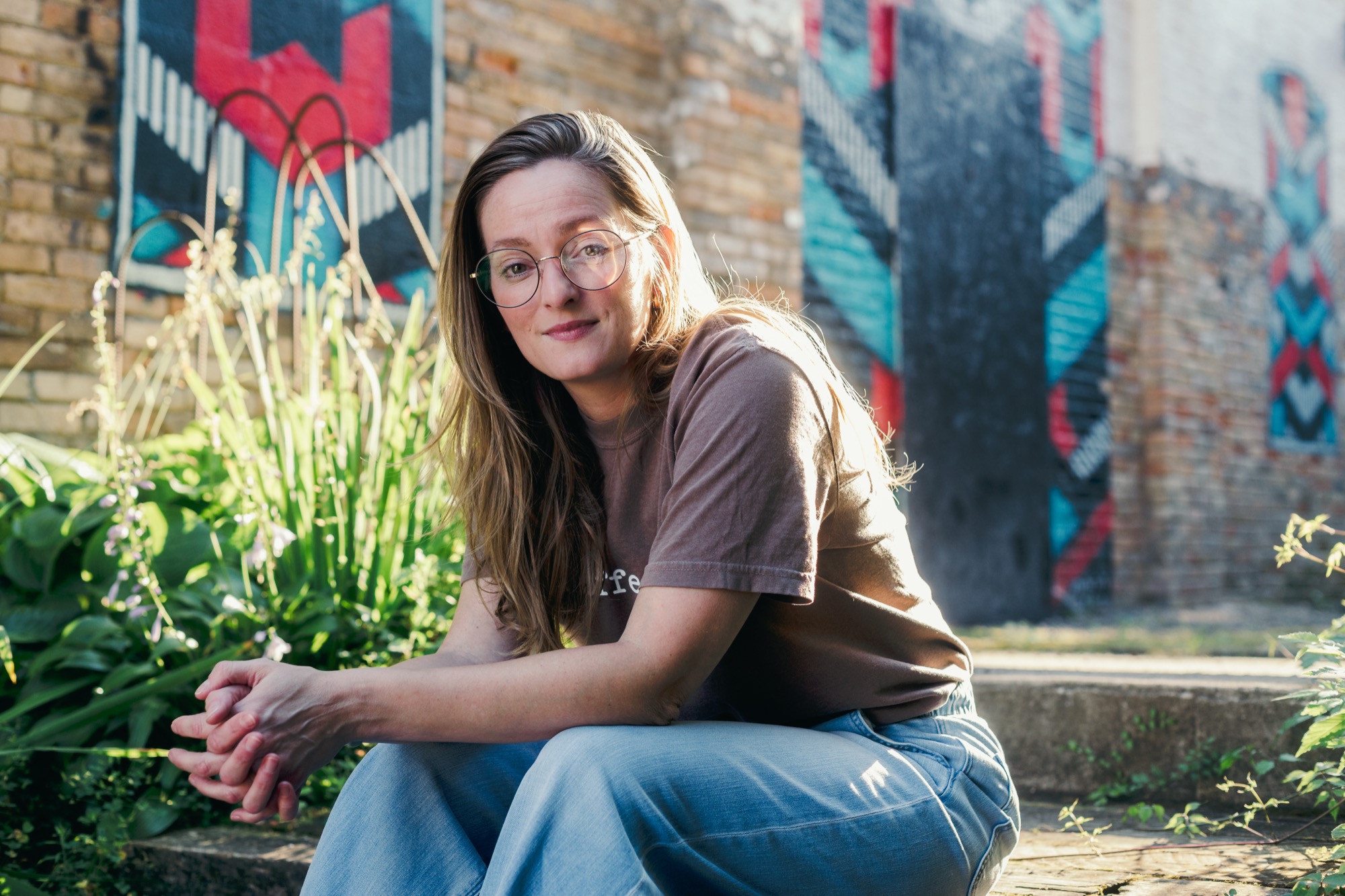
Art has always been central to Jessica Leeland’s life.
“I’ve always done it,” she says. “My brother was an artist. My parents were artists.”
Music, theater, and psychology – together with the visual arts – shaped her early creative world, giving her what she calls “the arts in the whole realm of my life.”
That foundation eventually led Jessica to discover art therapy in college, something she “had no idea” existed until professors recognized her ability to connect with others and encouraged her to explore it.
Jessica soon realized that art could be used not just for expression, but to help people.
“That was my favorite thing, finding out that you could actually help people by utilizing it,” she says.


Jessica initially planned to pursue clinical art therapy, but a sudden opportunity changed everything.
When a music teacher unexpectedly left a local elementary school, she was faced with a choice: continue the art therapy path, or help kids in a different, but related, way.
“I thought, ‘If I don’t jump now, I’ll never do it,’” she recalls.
Rather than waiting years to complete art therapy’s clinical requirements, Jessica chose to step into teaching and advocate for arts education where she felt it was missing.
“Kids need the tools now, in elementary,” she says.
In education, Jessica could give students access to creative tools early, before those opportunities disappear.
“You can still play sports and be an artist. You can still go be a doctor and be an artist. You just have to balance the schedule.”

In the classroom, Jessica merges artistic practice with therapeutic principles. She emphasizes pausing, reflecting, and making choices.
“It’s okay to pause,” she tells students. “And then watching them and hearing them speak the words, ‘no means no. Those are my boundaries.’ Those are healthy. This is OK.”
Jessica remembers one moment that confirmed she was exactly where she needed to be.
“A child told me they had never held a paintbrush before,” she says. “That was their first time painting. When that hit me, I knew I was meant to be here.”
Over time, she has seen the impact. Students repeat her language back to parents. Former 4H participants return and tell her, “You told me last year to do this.” For Leeland, those moments are everything.
“That’s game over for me,” she says. “That’s it.”


Despite the demands of teaching and family life – she’s married with two kids – Jessica remains committed to her own art.
“If I don’t create for myself in a certain amount of time, I become bitter,” she says. “It’s me flushing my brain out.”
Her Art 634 studio is essential – a place where her brain knows it is time to create.
Jessica’s work spans life drawing, paint pouring, acrylic painting , and ongoing experimentation.
“I’m very much a try it out, test it kind of person,” she explains.
Much of her work is human-centered, shaped by anatomy, psychology, and emotional experience.
“It just needs to come out of me,” she says.
While her art began as something “for nobody but myself,” sharing it has become part of the process. Teaching, creating, and continuing to evolve are inseparable for Leeland.
“This is exactly what I was looking for,” she says.
Follow Jessica's studio on Facebook

For Gary Willcock, art is something built from the inside out.
His story begins with buildings.
“I studied architecture at the University of Michigan,” he says. “I worked for a company in Pontiac called Custom Home Design, for Architonics here in Jackson, and I used to moonlight doing drawings at night. I got into a lot of places, met a lot of people, did some fun things.”
Gary grew up in Michigan’s Upper Peninsula. As he moved around the state, he was raised in houses without plumbing or a refrigerator, where every wall and nail carried meaning.
“All those structures had a special place in my life,” he says. “After World War II, there was a huge building boom. Every vacant lot disappeared, and I got involved in it somehow. When my dad decided to build a house, I was part of that. I didn’t know anything about architecture, but I liked designing houses. They told me, ‘That’s an architect.’ So off I went.”
Even after he left formal architecture for design and engineering work, the mindset stayed.
“Wherever I’ve lived, I play with the building,” Gary says. “If I see an empty building, I start massaging it in my mind.”


Gary and his wife Christie live on seven wooded acres south of Jackson, a place they call Wind Mountain.
“When I moved in here, this part of the house was just a covered slab,” he says. “I enclosed it, added a reverse gable, and kept going. Over the years, I’ve changed almost everything.”
He built patios, redesigned the kitchen, and drew every trim detail himself.
“This is all my design: the casing, the woodwork. I had it custom-made by the man who built my cupboards,” he says.
Christie calls their home “a living sculpture.” Gary agrees.
“At some point, I wanted my life to be a piece of art,” he says. “To live in this structure where I’ve created all this stuff. I’m walking through my own big sculpture, and it’s functional.”


Gary’s sculptures merge precision and imagination.
“I’m rigid in some ways,” he laughs. “Right angles all the way. That’s from my mother: you didn’t color outside the lines.”
His background in product and machine design shows in the materials he chooses: anodized aluminum, steel, acrylic, and found parts.
“I think of machines as robots,” he says. “Even a car is a robot. A robotic horse.”
His fascination with robots goes back to childhood.
“For some reason, I never got rid of a toy robot I bought in about 1948,” Gary says. “I bought it at Montgomery Ward in Royal Oak. It cost a dollar.”
Years later, his oldest son found a reproduction and bought it for him, sparking a new collection.
“Then somebody else gave me one, and another, and pretty soon it became a thing,” he laughs. Now, robots, along with dogs, fill his shelves.


“They all have personalities,” he says. “Some of my sculptures do too.”
Light is another essential part of his work.
“I enjoy how it plays off different surfaces, how it bounces around through the holes,” he says. “Some pieces have lenses. You look in one end and out the other, like a telescope.”
His sculptures often carry names that hint at humor and personality: Light Scope, Nest, Red Foreman, SEA AWL.
“I’m corny,” he admits. “But I like it when people lean in to look. Art should make you curious.”

Walk through Gary and Christie’s house, and every wall holds local art.
“If you want a creative community, you support it,” he says. “You show up to openings, you buy work when you can, you encourage people.”
“We buy it because we like it, not because we have to,” Christie adds. “The people who made this work are our friends.”
Gary smiles at that. “Art is connection. You don’t create in isolation.”

After raising six children and working full-time, Gary returned to art in retirement.
“I had to work, so all this was on the back burner,” he says. “One day I told myself, ‘If you’re ever going to do something, you better get off your seat and do it now.’ ”
Now an active member of several local art communities and collectives, Gary continues to draw, design, and build.
“I think art gives meaning to life,” he says. “It reminds us to look closer, to pay attention, to see more.”
Visit Gary's website | Follow Gary on Facebook
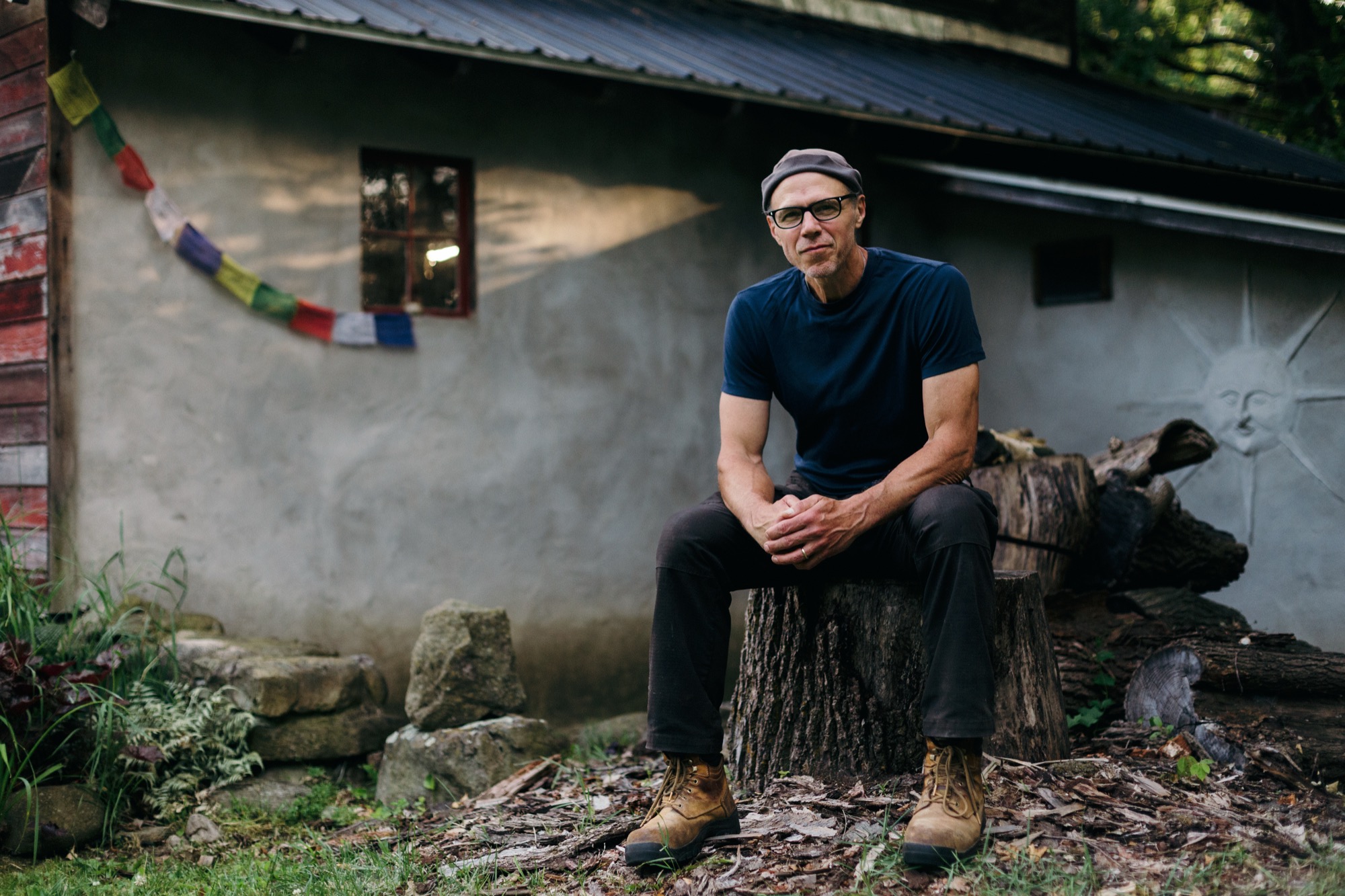
Tim Péwé creates art that moves.
Known for his figurative and kinetic sculptures, Tim’s work blends whimsy with craftsmanship. His pieces often balance, spin, or sway – sometimes, just for fun.
“A lot of this stuff moves or has a purpose, but it’s not like a practical purpose,” he says. “I like the idea of making something that does something, but there’s really no reason for it.”
Tim’s creative story begins far from Michigan, in the western U.S.
Growing up a creative kid in Albuquerque, New Mexico, and later spending time in Oregon, Tim was drawn to the outdoors and the tactile world of making things. His early fascination with Native American culture and ancient traditions, particularly those of the Hopi and Zuni tribes, shaped his artistic sensibility.
“We’d go to the dances at the Pueblo. That exposure made me more interested in a lot of different cultures,” he says.
Before sculpture became his calling, Tim built a career in construction and contracting. He specialized in marble and tile work, creating intricate inlays and custom medallions for homes and businesses in and around Naples, Florida.
“I always liked working with my hands,” he explains. “I started doing tile and marble, and then I’d make tables with inlays. It was creative, but it was also practical.”
Those years, and those early cultural touchpoints, taught him the skills and worldview that would later define his art.


Tim never studied sculpture formally. Instead, he learned by doing.
“I definitely progressed because a lot of the earlier stuff, when I look at it now, it’s kind of rough,” he admits. “I guess it was just experimenting.”
That spirit of exploration remains central to his work. For Tim, art is freedom.
“You don’t have a boss telling you no,” he says. “You’re your own boss. If someone doesn’t like it, that’s fine. And if someone does, that’s great.”


Today, Tim is best known for his figurative and kinetic pieces. His portfolio (and his property) is filled with curious representations and characters. In his studio, he’s carving a standing wooden figure. Out in the yard, there’s a head made of stone.
“To me, figurative art is more appealing. I don’t like abstract,” he says. “I always like just having an idea and thinking, ‘I’d like to see it actually exist.’ It’s almost like an invention.”
Tim’s studio in rural Jackson is a workshop of constant motion. He works with reclaimed materials, metal scraps, and wood, often starting with a single piece that sparks an idea.
“It’s the fun part to pick something up and then actually make it,” he says. “After it’s done, I’m not as worried about it anymore.”

Beyond his studio, Tim is an active presence in mid- and southeast Michigan’s art scene. He exhibits regularly in Detroit-area galleries and participates in local shows that bring together regional artists.
His work has become a familiar highlight at community art events, where its playful energy draws both collectors and casual viewers.
Brigit, his wife, sums up his appeal simply: “Tim’s work makes you smile. It’s clever and full of life.”
For Tim, that playfulness is the point.
“Either way, I just like making things,” he says. “If someone connects with it, that’s even better.”
Visit Tim's website
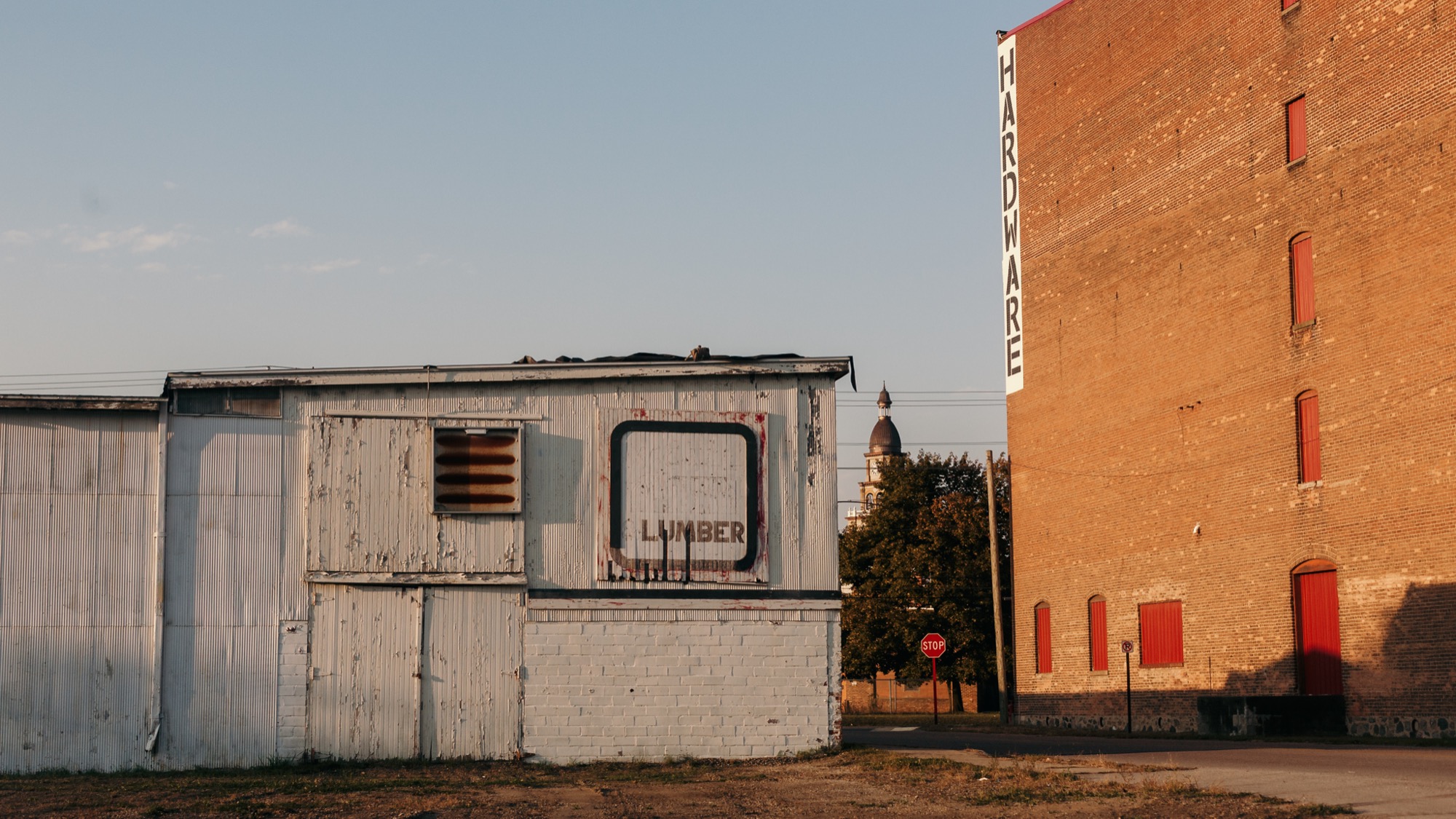
Another Saturday morning, another small town in south central Michigan.
This time, I picked a sunny fall morning and drove south to Hillsdale, a small town that I haven’t seen in 15 years. I used to travel to Hillsdale for work fairly often. Today, it’s all photography, and a fresh chance to revisit this small city.
Hillsdale is about a 40-minute drive from Jackson, through the rural countryside, and it was a good opportunity to get to see this section of US-12 again.
The first stop? Lewis Emery County Park to watch the sun rise.


I met this gentleman who was struggling to find a fish.
“What are you photographing anyway?” he asked.
The scenery, I said, and to watch the colors change as the light came in.
“Well, if you see any fish around, send them my way,” he said.


Driving into town, I spotted this industrial section of town and pulled over to explore. The sun was coming up and lit up these bright white silos perfectly.
On the town square, near the courthouse, I walked around the farmers’ market and bought a delicious selection of apples.


At the farmer’s market, I ran into a co-worker and her friend.
“What are you doing down here?” she asked.
Have camera, will travel, I said.


Photos shot with the Canon 5D (classic!) and either EF 50mm f/1.4 or 40mm f/2.8.
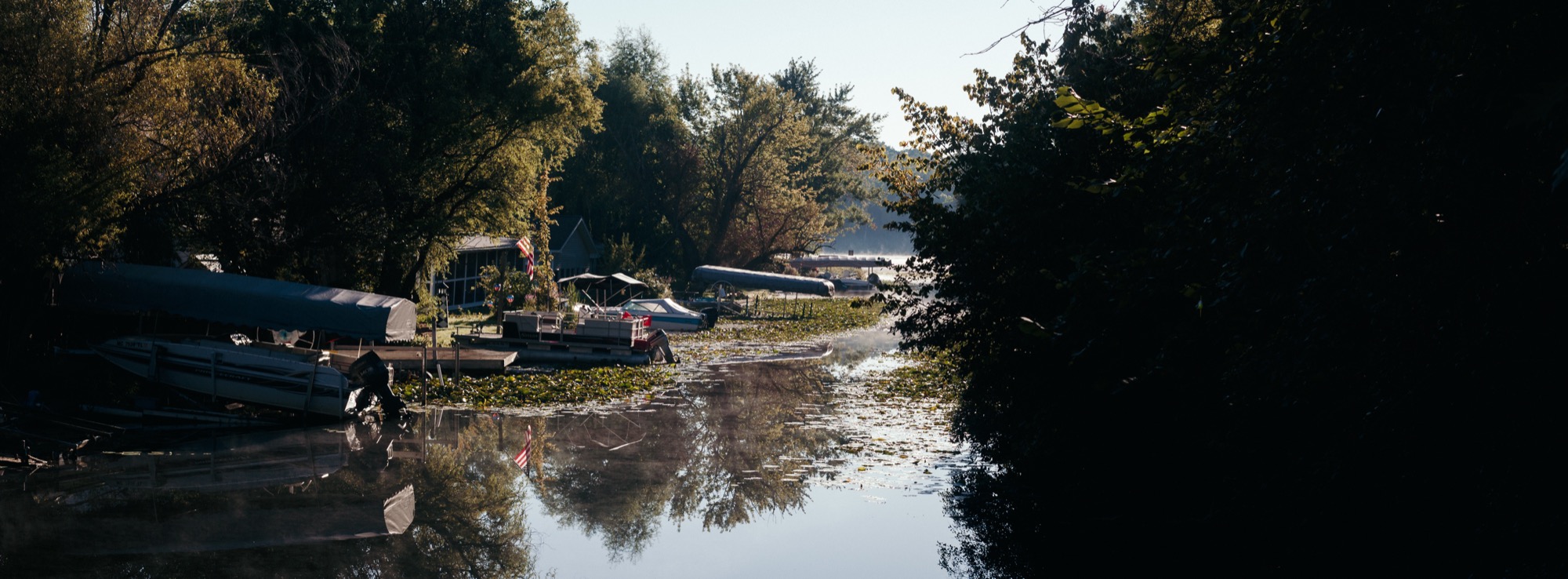
The Irish Hills in south central Michigan continue to be an ongoing project – one of the places I return to, time and time again, to capture an area that I love.
Except it’s been nine years since I was out this way. Much has changed.


I brought along the Canon 5D Mark II and both the EF 40mm and 50mm lenses, and started with the little lakes that run along US-12.
As luck would have it, the fog rolled in on this cool September morning and made for some good imagery down these long country dirt roads.


Further East on US-12, I stopped to revisit the amusement parks and classic Irish Hills roadside stops that I’ve spent years photographing.
Sadly, many of my old haunts were either torn down or converted into unrelated businesses (Prehistoric Forest, for instance, is now a golf cart rental shop). A lot can change over nine years.
To me, seeing all these classic Irish Hills stops being torn down or transformed means it’s more important than ever to photograph them before they’re gone.


Just a little further down US-12, I stopped by a few more lakes – Sand Lake and Evans Lake – because they still had a little bit of fog, and the light was just right.
The bright reds, especially, stuck out from the background of blue and green on these lakes.


Before the light disappeared, I headed back to my hometown of Brooklyn, Michigan, and stopped at a marina for some more boat shots before the fog burned off completely.
I grew up in this area. It’s always nice to revisit these familiar scenes when the morning light is just right. Photographing a place you love shows a special kind of respect.


Part of these morning trips involves simply driving around, exploring, and seeing what scenes catch my eye. Dead ends are never a bad thing – it’s all about the adventure.
So when leaving Brooklyn, I stopped at a few final places to look at them with a photographic eye.
It’s home, reimagined.
Shot on the Canon 5D Mark II with the EF 50mm f/1.4 and 40mm f/2.8.
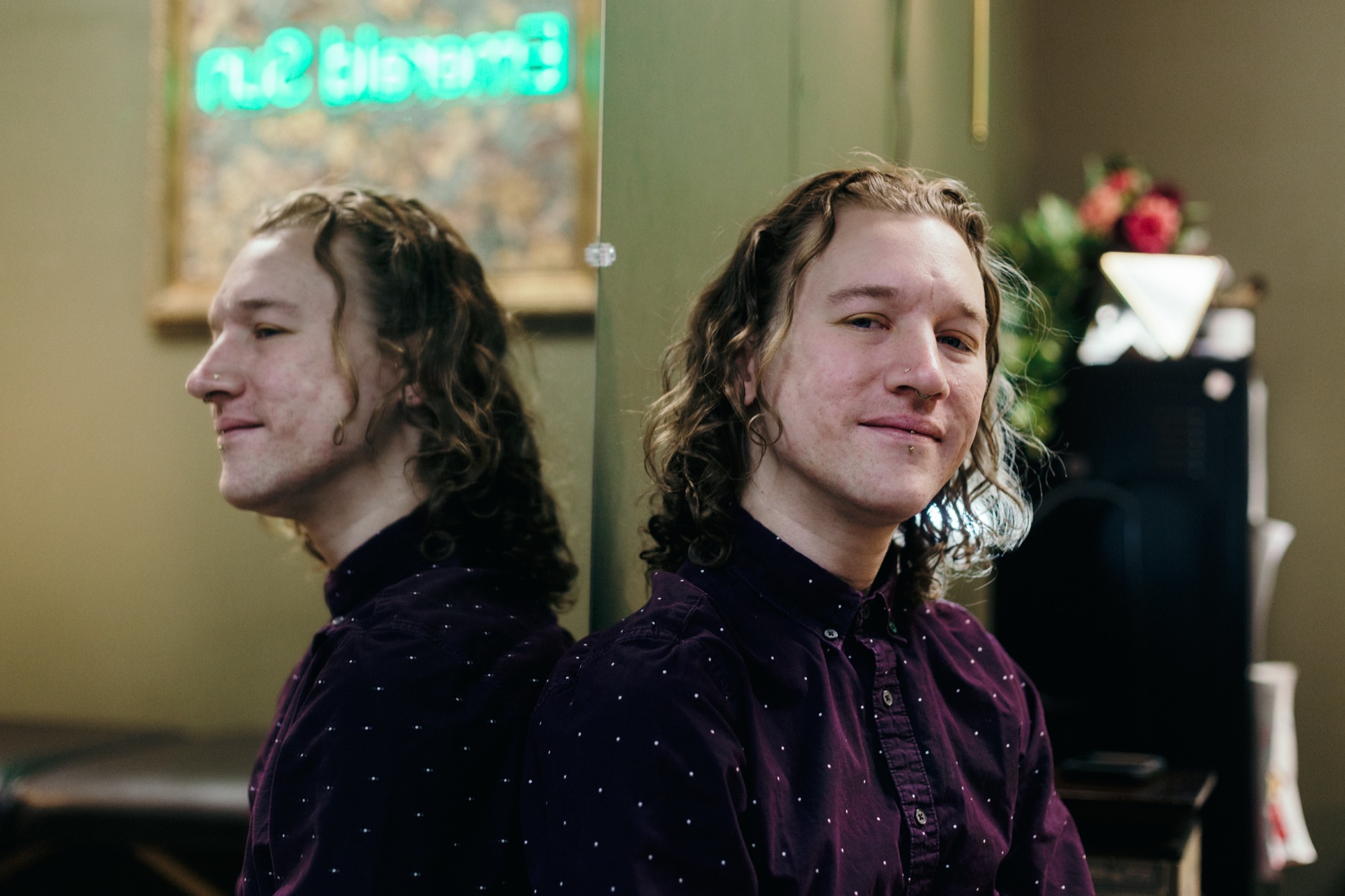
Inside the welcoming walls of 21 Blooms Tattoo Studio, Dylan Sodt (he/they) is quietly reshaping how people see themselves, one piercing at a time.
Dylan is a piercer, but that barely scratches the surface. For them, piercing is not just a form of body modification. It’s a practice of empowerment, trust, and transformation.
“I can build a little home with people in 30 minutes,” they say. “It creates a ritual environment. It’s an energetic exchange. They’re trusting me—and that’s when I think I have the best job.”
Born and raised in Jackson, Dylan’s path to piercing was anything but linear. He started by sketching the human figure as a kid and later found creative expression as a drummer in local bands. For much of his adult life, Dylan worked in restaurants, eventually managing the bar and kitchen at Sandhill Crane Vineyards. But even while building menus and leading teams, a deeper pull was growing.
“I hit a point where I needed something new,” he recalls.
Just two days after leaving the vineyards, he began a piercing apprenticeship.
“Piercing found me,” Dylan says.
 That leap of faith led them into a world where artistic intuition and technical precision are inseparable. Their practice is steeped in anatomy, geometry, and material science.
“It’s engineering on a smaller scale,” Dylan says.
Before he started working with Lauren Maureen of Emerald Sun Studios, Dylan had to start at the beginning: an apprenticeship.
Apprenticeship is the cornerstone of ethical piercing, and Dylan’s journey was a slow and deliberate one.
“You don’t even touch a needle for months. You learn the biology of wound healing, jewelry angles, and sterilization.”
But even more than technique, piercing is about people. Dylan specializes in body reclamation: helping those who have experienced trauma, abuse, or body dysmorphia reconnect with themselves.
“I want clients to feel more empowered when they leave here,” they say. “I’ve had clients squeal when they see themselves in the mirror. That sound? It means everything.”
Their work is artistic and deeply personal. Dylan observes each client closely: how they dress, carry themselves, the undertones of their skin, hair, and eye color.
“I have 30 minutes to clock your style,” he says. “It’s like painting on someone else’s canvas. Then it walks out the door and lives a whole life.”
From simple lobe studs to advanced curated ear setups, every piece is placed with aesthetic intention and precision measured in millimeters.
“We have to create the illusion of symmetry. If it’s off, people will feel it. Others will notice.”


Empowerment doesn’t come without responsibility. Dylan sees self-confidence as a professional obligation.
“You need a god complex to do this work—not arrogance, but self-respect,” they say. “You have to put clients at ease. There’s no room for shaky hands.”
They draw on Buddhist practices like breathwork and meditation to stay grounded and present, offering their clients not only a piercing, but also a moment of calm and clarity.
Outside the studio, Dylan finds creative joy in cooking—“an art form that doesn’t belong to me,” they say. “It’s all colors and flavors, and then it’s gone in 15 minutes.”
They surround themself with earth tones, thrifted treasures, and houseplants, always seeking to breathe new life into the old. That ethos flows directly into their work.
“What I do gives people a new image of themselves,” they say.


At 21 Blooms, Dylan has found a creative home. The studio, owned by Emily Radke and envisioned as a hub for full-time piercers, is more than a workplace.
It’s a collaborative sanctuary.
“We push each other here,” Dylan says. “We talk through designs, hold critique nights. There’s a vulnerability in that, but it makes us all better.”
For them, the studio is also a commitment to raising the standard in Jackson.
“This city deserves a proper piercing space. If you get pierced by me, I consider you a client forever. I’m an island of proper piercing.”
Looking ahead, Dylan is pursuing certification with the Association of Professional Piercers (APP), a national standard of excellence in the field.
“There’s no ceiling in this work. You can always get better,” they say.
From the restaurant floor to the piercing chair, and no matter their tools, Dylan has always been in the business of care.
“I’m in service of an idea,” they say. “That people can see themselves differently. That they can walk out of here and feel like they belong to themselves again.”
Follow Dylan on Instagram

Love this Bloggers portrait project by Gabriela Herman.
Simple, stark, drenched in shadow – just my style.

Welcome to Homer.
It’s hot – early July, mid-day hot. And quiet. Homer is a sleepy rural village in southern Michigan.
Americana was on full display walking around the village square just after July 4.


Shot on the Canon 5D (classic!) and EF 50mm f/1.4.
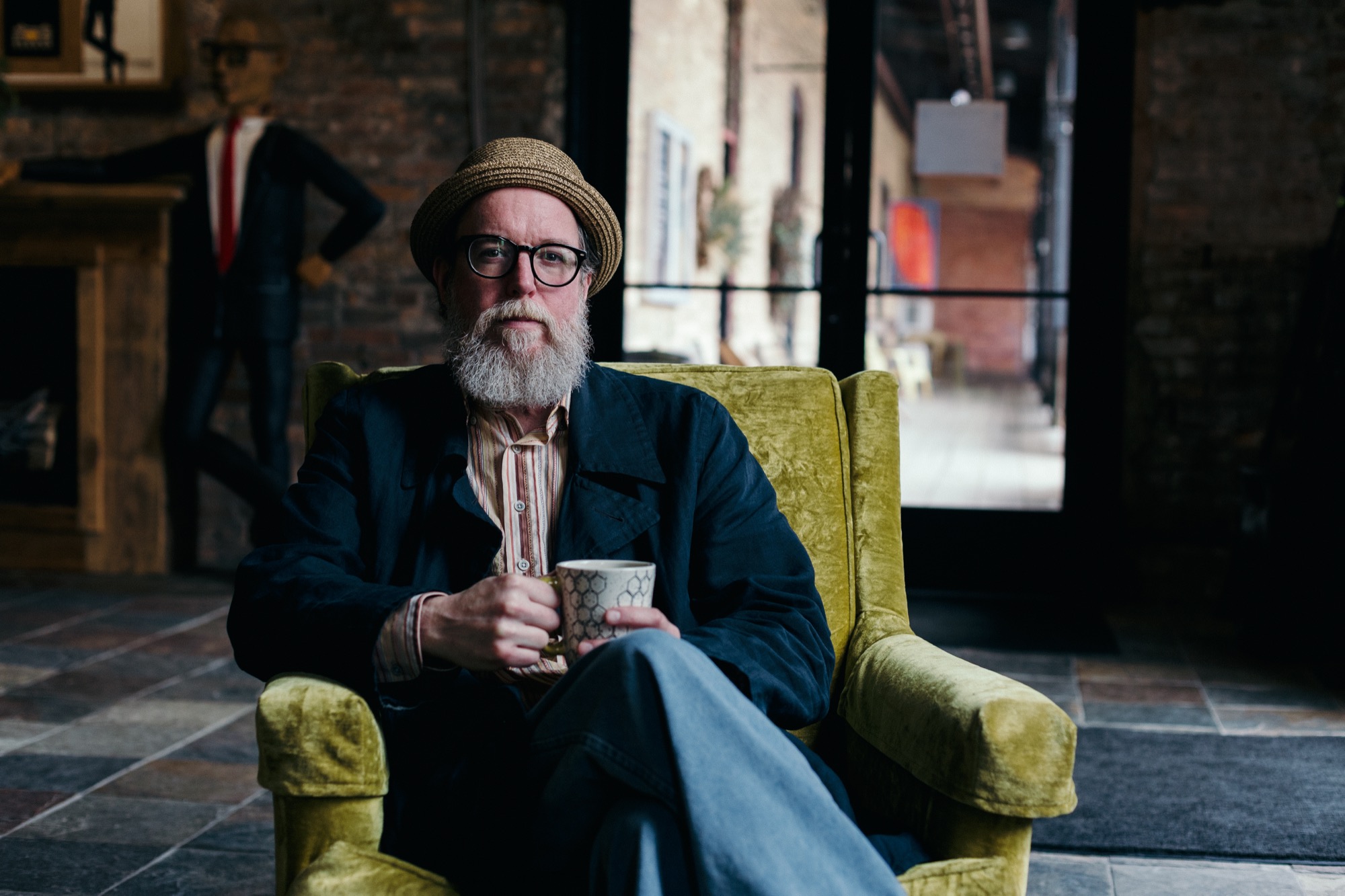
Tucked in a cozy corner of Art 634 in Jackson, Michigan, Jason Heinrich’s Yesterdream Studio isn’t just a storefront. It’s a portal to comfort, creativity, and memory.
Admittedly, the space defies easy classification.
“It’s not really a furniture store, not really a record store, not really a gift shop,” Jason says with a laugh. “But it’s also all of those things.”
Growing up in a Downriver factory town in the 1980s, Jason was surrounded by the aesthetic leftovers of previous decades: glass lamps, mid-century furniture, the sound of rock and roll.
“Especially in finished basements and cottages, there was always that old stuff from the ’60s and ’70s. It was everywhere,” he says. “That became my comfort. I didn’t know it then, but I’ve always been chasing that feeling.”
At Yesterdream Studio, that sense of comfort is Jason’s goal. Everything in the space invites visitors to slow down, remember, and then use the items in the shop to make their own space comfortable.
“Transforming your space can transform your mental health,” Jason says. “If you’re surrounded by things that bring you comfort, it affects your mood. That’s a big part of why I do this.”


Jason’s journey here hasn’t followed a straight line. After starting out in fine arts, he spent several years as a laborer in the plumbing trades, his family’s profession stretching back generations. Later, he earned a certificate in graphic design and worked in marketing roles for various Michigan associations. That work included working as a graphic designer and social media manager for marketing departments
 But every time he stepped away from art, something pulled him back.
“I’ve tried to reinvent myself so many times,” he says. “But creativity always finds its way back in. I don’t go looking for creative work. It just kind of finds me.”
He opened Yesterdream Studio in 2023 at Art 634, after years of collecting, designing, and repurposing, while continuing to work on freelance graphic design and marketing projects.
Jason says his work revolves around sustainability.
“One of the biggest parts of this place is to reimagine, repurpose, and reuse,” Jason says. “There’s no reason to buy brand-new when you can take something old, paint it funky colors, and give it new life. And it’s better for the environment.”
His love for natural patinas and vintage design finds its way into the usefulness and beauty of everyday objects. For an example, Jason points to a large metal tackle box on his shelf.
“People throw stuff away because they don’t see the value. But to me, this tackle box is beautifully designed. It could be anything—a painter’s box, a face painter’s kit, whatever,” he says. “That’s what I love about it.”
Jason’s love of vintage also extends to running a local steampunk convention.
His journey from Renaissance fairs to Steampunk festivals began in the early 2000s. After discovering Steampunk in 2011, he launched monthly events and co-created the Gears, Beards, & Beers competition. Partnering with DJ Van Helsteam, they later hosted the Monster Hunter Bash.
When Michigan’s Steampunk scene slowed during the pandemic, Jason found new inspiration at Art 634. In 2023, he launched Steampunk on the Bricks, a one-day festival that blends workshops, live performances, and integrated vendor experiences. Now in its second year, the event draws hundreds from across the Midwest thanks to support from Art 634, Experience Jackson, and Manchester Underground.


Jason is productive, often jumping from project to project—painting, cooking, woodworking—and he rarely sits still for too long.
“It’s kind of like checking things off a list,” he says. “One minute, I’m carving a walking stick, and the next, I’m painting a side table. It’s all over the place, but it works for me.”
Above all, Jason wants Yesterdream Studio to provide an antidote to the intensity of modern life.
“The world’s gotten meaner,” he says. “People are stressed out, trying to survive. We’ve lost compassion and grace. I wanted to build a space that reminds people to slow down, to breathe.”
His space also invites other artists, including his colleagues from Art 634, to collaborate and network, which helps create a productive, inspiring space for Jason to dabble and create.
“I just want to be around authenticity,” he says. “No personas, no fakeness. Just real people being real. That’s what this space is about.”

This is an old neighborhood in Jackson, Michigan.
Here on Wildwood Ave and Edward St, behind the public high school, you can sense the age in the size of the homes and their proximity to downtown Jackson.
It’s quiet. A little under construction. And here on a sunny day in early May, there’s plenty to see.


Shot on the Canon M6 and EF-M 28mm macro.
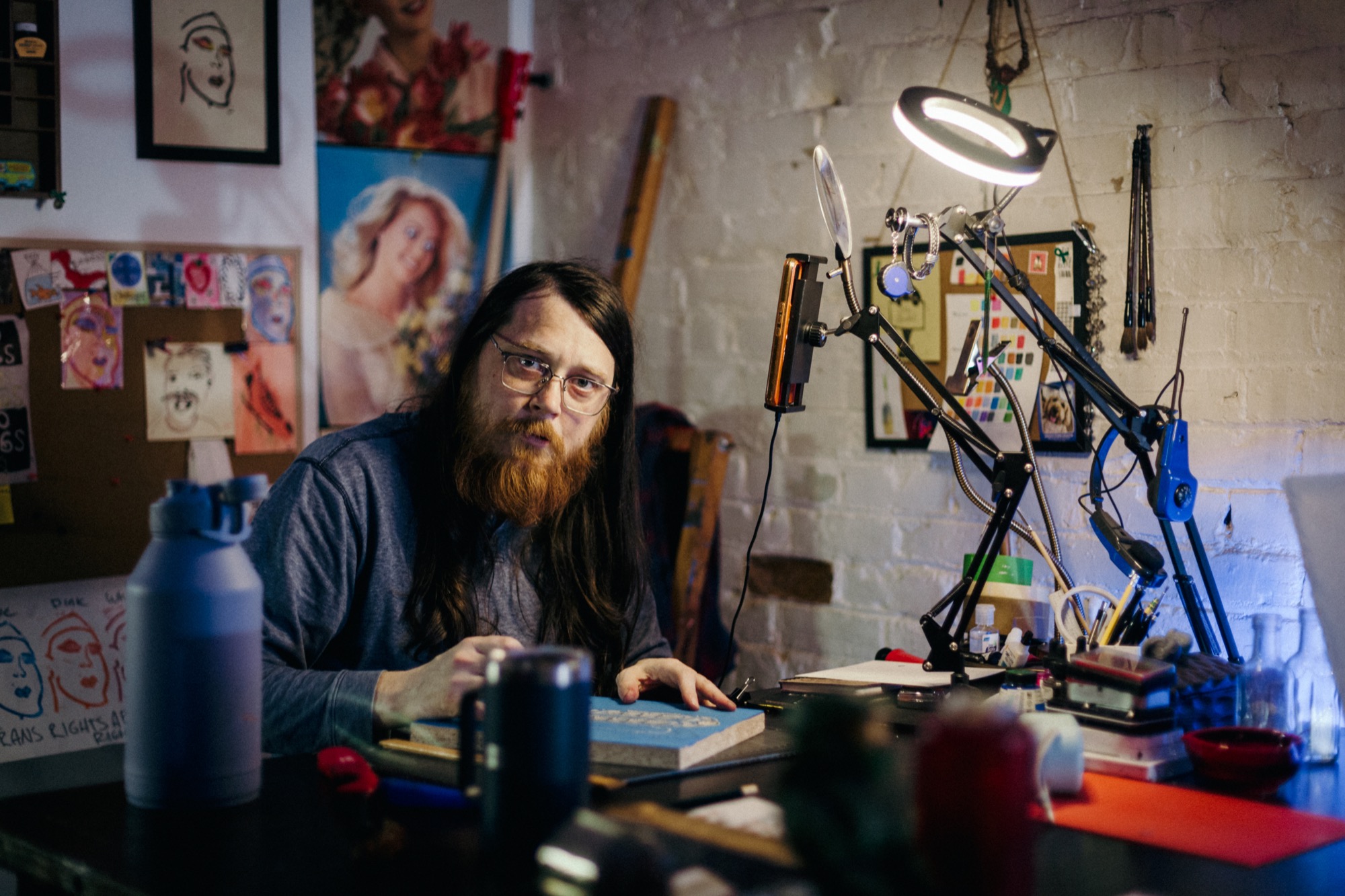
Creativity and transformation define Logan Swoffer’s artistic journey.
As both a musician and printmaker, his artistic evolution is deeply tied to his lived experiences that were shaped by hardship, discovery, and ultimately, a second chance at life.
His near-death experience in 2023 profoundly changed his perspective, instilling a newfound appreciation for beauty and a drive to create.
Logan was born in Jackson, Michigan, but his journey took an early turn when he moved to Arizona with his mother and stepfather in the fifth grade.
Settling in Deer Creek near Flagstaff, he discovered his passion for music at 14, picking up the guitar and finding that creativity “flipped on like a light switch.” He also dabbled in graffiti and doodling, though his artistic pursuits remained mostly informal at the time.
In 2005, after high school, Logan began traveling back and forth between Arizona and Michigan. Eventually, he and his mother left Arizona for good, escaping a difficult situation with his stepfather. He reconnected with his biological father, a poet and printmaker, and the more time they spent together, the more Logan saw their similarities.
“He was a scoundrel, so I come by that naturally,” he jokes.
His father’s work in printmaking would later become a major influence on Logan’s artistic career.
During this period, Logan became immersed in the local Jackson music scene while working various jobs, including a long stint in medical billing. Music remained a core part of his identity, but his artistic journey had yet to fully take shape.


Years of heavy drinking caught up with Logan in 2023 when he fell critically ill.
At the time, he was working at Unleashed and Loving It when he began experiencing aches and fatigue. Friends and coworkers noticed his declining health, but it wasn’t until his mother intervened that he finally sought medical help.
Doctors diagnosed him with hepatic encephalopathy, a life-threatening condition caused by liver failure. Days away from death, Logan was rushed to Detroit for a liver transplant in May 2023.
Reflecting on this experience, he describes it as a complete transformation.
”I didn’t do a 180; I vanished and came back a different person,” Logan says. “One week you’re going to die, then you go to sleep and wake up a changed person. It’s a beautiful thing.”
His recovery was swift, but the experience left a profound impact on his outlook. Now immunocompromised and managing ongoing health risks, Logan embraces his “new normal” with gratitude and determination.


Following his transplant, Logan found himself drawn to beauty in a way he never had before. Seeing an Instagram post about printmaking ignited a deep passion within him.
“It lit me up like a firecracker,” he says.
Though he had never considered himself a visual artist, he quickly embraced the medium, exploring printmaking, watercolor, and mixed media.
“Maybe I got a bit of my liver donor’s soul, but something changed,” Logan says. “I saw things I didn’t use to see.”
His art often blends delicate floral imagery with bold political statements, advocating for trans rights and marginalized communities.
“Print is the perfect vessel. I can put it up wherever I want. Say what I want. The pointedness is out of necessity,” he says.
While he strives to balance political messages with beauty, he acknowledges that art is a powerful tool for activism.
 Logan’s sobriety is deeply tied to his gratitude for the second chance he’s been given.
“I do it out of respect for my donor, who died and gifted me with this new lease on life,” he says.
He has since built a strong community of sober friends who support one another in their shared commitment to a healthier lifestyle. Since January 2024, Logan has been working out of Art 634, where he’s found another supportive and inspiring community.
“You could make art anywhere, but going to a creative space? I just love it here,” he says.
He hopes to contribute to Jackson’s cultural revival by expanding his reach through zines, exhibitions, and collaborative projects.
Looking ahead, Logan remains focused on growing his artistic presence.
“I could’ve gotten into archery or race cars, but I saw that printmaking video, and that’s what stuck,” he says.
Through music and printmaking, Logan channels his gratitude, using art as both a personal outlet and a means to inspire others.
Follow Logan on Instagram | Shop Logan's Store

When Madison McCarver walked into 21Blooms Tattoo Studio in Jackson, portfolio in hand, she was terrified.
She was looking to leave her job in Toledo, where she had apprenticed and worked as a tattoo artist, but she wanted to be closer to home in Ann Arbor.
Taking a deep breath, she introduced herself to the 21Blooms team, laid out her work, and braced for rejection.
Instead, they simply asked, “When can you start?”
It was a moment of validation for Madison, who believes she manifested the life she wanted—one filled with good people, a welcoming environment, and creative freedom.
“This is a good environment,” she says. “Usually, I want to leave work and go home, but here, we’re hanging out in the studio until 8 p.m. because we love what we do.”


Art has always been Madison’s escape. As a child, she dabbled in fine arts, portraiture, and even fashion design. In school, her art teachers recognized her talent and submitted her work to competitions, boosting her confidence.
Though she once dreamed of moving to Los Angeles to study fashion, life took a different turn when she enrolled at Washtenaw Community College, where she fell in love with figurative arts and painting.
In 2020, stuck at home during the pandemic, Madison often found herself painting and drawing for 10 hours a day—until burnout set in.
Looking for a change, she took a job at a beauty spa in 2021 but quickly realized the environment wasn’t for her. When she got her first tattoo that year, something clicked. Madison realized tattoo art could become a career.
She started her tattoo apprenticeship that same year, driving from Ann Arbor to Toledo three times a week, practicing on fake skin for nearly a year before moving on to real clients. By 2022, she had graduated from her apprenticeship and officially entered the industry.
Now, three years in, she’s found her rhythm.
“This industry has its challenges, but at the end of the day, I get to draw on people,” Madison says. “Now, I couldn’t see myself doing anything else.”


Madison’s art is a fusion of influences: her mother’s love of Rococo, the powerful works of Kehinde Wiley, and the delicate textures of Laura Brevner’s feminine portraits.
She leans into period fashion, the female form, and a mix of vibrant, poppy colors with classic undertones.
Music also plays a significant role in her creative process, from ‘70s funk and soul to modern pop.
“Music influences how I create art. I’m both visual and auditory,” she says. “And that’s my style: colorful, poppy, but classic.”
 Early in her tattoo career, Madison needed a way to make ends meet, so she took a job as a painting instructor at a paint-and-pour studio. Teaching helped her develop patience, communication skills, and a fresh perspective on art.
One moment that stuck with her was working with an older couple who doubted their abilities.
“I had to reassure them: ‘It doesn’t have to look like mine,’” she says.
When they later told her she was an excellent teacher, it reminded her of the impact art—and encouragement—can have on people’s lives.
Looking ahead, Madison wants to continue exploring new artistic avenues. She still paints and is learning oil techniques, dreams of a solo art show, and even dabbles in fashion and cosplay. While tattooing remains her main focus, she hopes to blend her passions in unexpected ways.
“My canvas is skin, but I still love painting,” she says. “I just have to figure out how to meld the two.”
Madison manifested art into her life. Now she can’t live without it.
“If I don’t have art, I might die,” she laughs.
Luckily, at 21Blooms, she’s found a community that supports her growth, shares clients based on specialties, and encourages creativity.
“I’m a lot happier here. Things are good.”
Follow Madison Sky on Instagram | Madison Sky at 21 Blooms Tattoo Studio
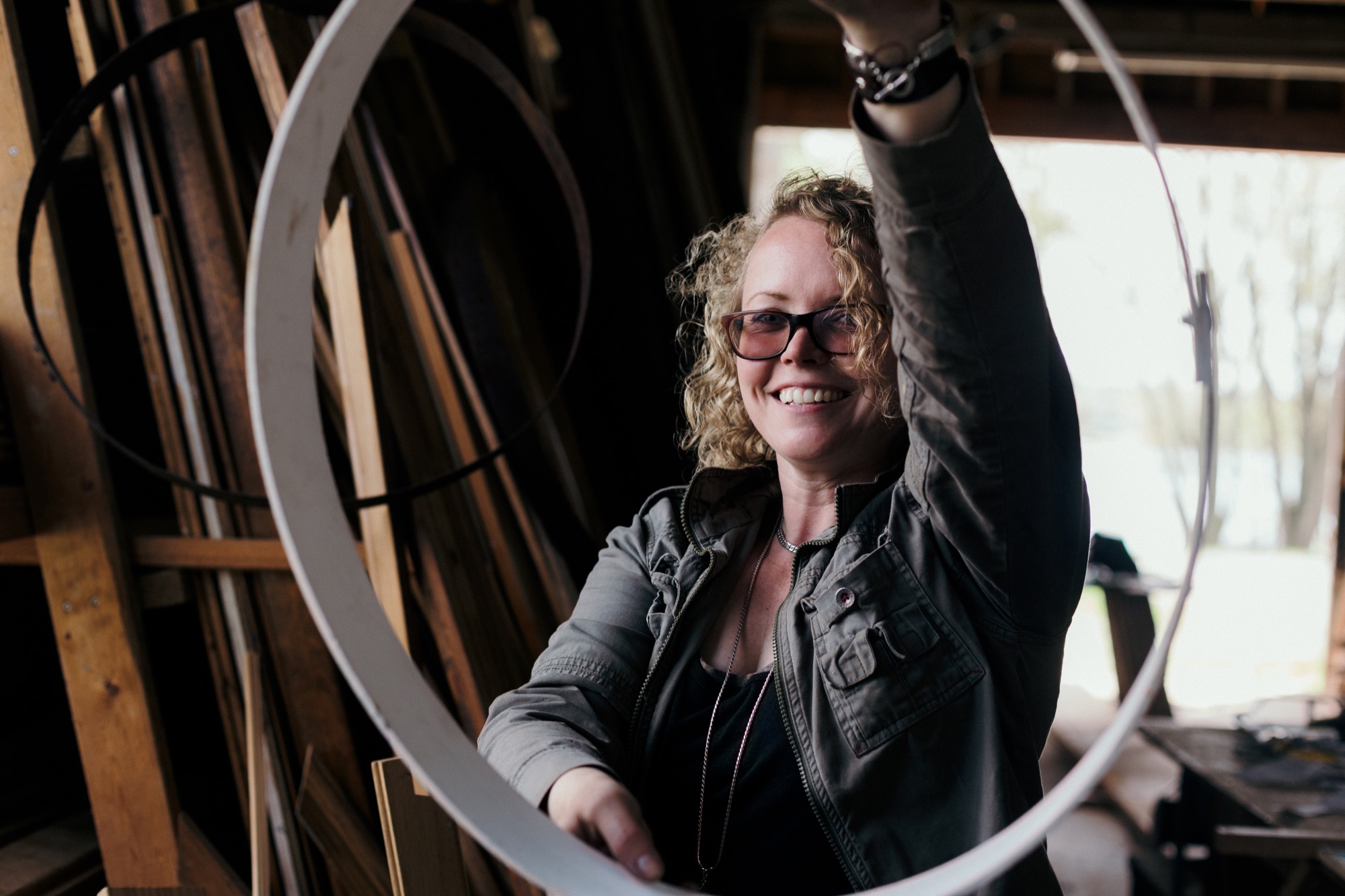
Dione Tripp doesn’t just make art—she builds it, reconstructs it, salvages it, and reimagines it.
Growing up in a family of carpenters, inventors, and tinkerers, she was surrounded by the idea that anything could be created with the right tools and vision. Her father was into music, her mother into art, and somewhere in between, Dione found her own voice—one that blends mediums, textures, and emotions into something distinctly her own.
 Her artistic journey began with singing, painting, and the idea that she might one day become an art teacher. But she quickly realized her passion wasn’t in teaching—it was in making. Hanging art at the old Thunderbird Café, creating gifts, and submitting pieces for Jackson’s Cool City initiative, she steadily built her presence in the local scene.
Over time, her work evolved beyond traditional canvases into something more layered and more experimental. Even a routine car repair becomes an opportunity. When she gets her brakes changed, she keeps the parts, seeing in them a potential for reinvention.
“How far can you push an object to be a sculpture and not be too crafty?” she asks—a question that continues to shape her process.


Dione pulls from her environment—barn scraps, salvaged materials, even discarded brake parts—to create works that challenge viewers’ perspectives.
“If you’re in a plane, you can see the world differently. I want to express that: the dangers, the fears, the freedom,” she says.
Jackson, Michigan, remains central to her creative world. She studied there, works there, and thrives in its grassroots art community.
“It’s like a blank slate, and we can create our own answers,” she says.


With two to three projects per year, she’s constantly exploring—be it through book illustrations, her new clothing store, or sculptural ideas. While she’s open to branching out, she doesn’t feel limited.
“The only thing limiting me is myself—both in terms of my art and my success,” she says.
Looking ahead, Dione is driven by a desire to amaze herself and find collaborators and appreciators along the way.
“I want to be able to toss ideas around, learn new skills, and try things out,” she says.
Whether it’s trading art, experimenting with new media, or diving deeper into sculpture, she’s on a path of constant evolution—one where every scrap, stroke, and salvaged element has the potential to become something memorable.
Buy the Artists In Jackson book | Artist Dione on Instagram
Ten years ago, I introduced my first big creative portrait project called Artists In Jackson. Through that project, I got to know our local artists. Together, we told their stories and let our community know we have a talented bunch of people right here in our hometown.
And – bonus! – I met and made some good friends along the way.
Since then, a lot has changed. I worked on a spiritual sequel, Musicians In Jackson, and then the pandemic hit. Here we are five years later, and I’m happy to announce I’m working on my next big portrait project, Artists In Jackson 2.
This one will be a little different. Instead of disappearing for six months and re-emerging with a fancy book and a bunch of pictures, I want to treat this project more like a platform.
Here’s how it works:

At a point in time, when I have enough profiles done, I can collect them all and make a book or a ‘zine of some kind.
But that’s not the goal. The goal is to tell stories about creative people in our community.
And I have some profiles already set up to publish – one, reaching back several years, on Dione Tripp (above). Others I have a head-start on and you’ll see those soon. As always, I’m open to your ideas and tips on creative people in and from Jackson.
I hope you’ll join me in this new experiment. I’m excited to once again share these homegrown artists, their work, and their stories.
Get all the details at ArtistsInJackson.com.

So far, so good.
I’ve successfully launched four email newsletters this year. Not bad for starting totally fresh.
Content-wise, I’ve covered everything from sunshine to digicams and shared proud parent moments and books I’m into. Along the way, I’ve also added some new subscribers (thanks!).
Catch some of the action by subscribing here. I hope to see you in your inbox.

I think the pain and frustration we feel when we’re confronted with our lack of talent and skill is also the path to overcoming our talent ceiling. The pain an athlete feels when exercising is the proof that they are getting stronger.
Shawn Blanc: Overcoming the Talent Ceiling
Bingo. I’m always thinking, “I wish I could do that.” So usually, I go out and learn how. And keep at it until I’m satisfied or move on.

I’m kissing Squarespace goodbye and moving my two portrait projects to my blog. Instead of sending web traffic somewhere else, Artists In Jackson and Musicians In Jackson—as they’re updated—will live here, where visitors can learn more about my other projects.
As I was putting together the project landing pages, I remembered JTV’s Bart Hawley Show featured Musicians In Jackson late in 2019, but I never shared that conversation on this blog.
So here it is. And many thanks to Bart for having me on to talk about my musicians and artists portrait projects.

Let’s try this again.
After I launched my Artists In Jackson project, I also launched an email newsletter to keep my subjects and buyers updated. Over time, it became a periodic vehicle to share what I was doing, interested in, or working on.
Then, midway through the pandemic, I lost it. I couldn’t bring myself to work on it like I wanted to, and the newsletter slipped away from me. Mailchimp closed my account for inactivity, and I lost all the momentum I had built.
Now I’m relaunching my email newsletter with beehiiv, and I invite you and anyone interested to sign up (or re-sign up) and join me as I get this thing started again.
I’m shooting for monthly or bi-weekly, and I may try out a few new formatting ideas, but mostly, this newsletter will be an update, a few items I found around the internet, and some new blog posts.
Subscribe here, and talk soon:

I like my holiday season to be truly peaceful.
Quiet music, winding down the to-do list, cozy days at home catching up on movies, and looking back on the year that was – that’s my ideal Christmas.
Yes, we have the spirited family get-togethers and the hustle of Christmas morning with the kids. There’s all that shopping and cooking. But mentally, when I think of Christmas, I think of a quiet season—peace on Earth, goodwill toward men, that kind of thing.
This year, I’ll use the quiet to plan ahead to next year and develop some ideas.
There are always more ideas than time and energy to see them through. That’s just how I work.
But mulled long enough, like a fine dark wine or some spiced cider, good ideas get better with age.
Settle in. Enjoy the season. See you all in the new year.

On our way up north this summer, I took the scenic route (as I often do) through the little towns of Stockbridge and Perry, Michigan. Along the way, I made a mental note to stop by both towns and take photos.
I picked a foggy morning on the first day of autumn to head up to Stockbridge. I’m glad I did, because the mist gave the town square a vibe. I made a whole morning out of it, shooting along the way and back home, and it ended up being a really productive (and fun) day out.


Shot on the Canon 5D with a combo of the EF 28mm and 40mm.

Year after year, Flickr keeps trucking along. It’s still my favorite photography social/sharing platform. I’ve “met” so many great photographers on the site.
One of my go-to favorites is Zach Huggins out of Texas.
Where are you, and what do you do?
I live in Oak Cliff, a small neighborhood in Dallas, and I work as a scanning technician at an art printer. I scan artwork for printing.

How did you get started in photography?
I had a few cameras when I was a kid and in high school, and I loved snapping shots with those, but I didn’t really get into photography until college. I was a film major and I took my first digital camera on set to take behind the scenes photos, and that was when I was hooked.

What do you like about your photography, or photography in general?
I draw a lot of inspiration from movies and film, so anytime I get a photo that looks like it could be a film still, it’s a win for me. I like it when my images imply a story that started before that frame and continued after it. I love visual language, and to me, filmmaking and photography are siblings.
One of the things I love most about photography is that it has kept me curious about the world and people around me. It really is the art of seeing.

I got to know you through Flickr, where you manage several groups and bring a real sense of community to fellow photographers. What do you enjoy about building communities and sharing with other photographers?
One of the things that keeps me inspired is looking at others’ work, and Flickr is still one of the best places to see a wide variety of photography and meet other photographers. I also appreciate that, unlike a lot of other photography-oriented sites, I’m not inundated by ads and bots trying to sell me things. It keeps the focus on photography, and that’s why I have stuck around.
Originally, I started getting more active in groups to keep active on here when COVID shut down the world and I wasn’t able to go out and take the kind of images I’d like. I’ve found it’s a great way to find new photographers.

Your photos feature friends, your community, and different events you attend. Do you keep a camera with you at all times? What inspires you to shoot what you do?
That’s another thing I like about photography! It keeps me social and going out. If I want to take interesting photos, I have to go interesting places and meet interesting people.
I started carrying a camera with me at all times a long time ago, and that’s the number one thing I recommend to anyone wanting to get more into it. I got tired of seeing cool things and not being able to capture them (this was before cell phones had cameras worth a damn), so I started carrying one every day.
Even now that smartphones are pretty good, I like to have a camera because it makes me a little more intentional with my shots. If you are lugging something around and the only thing it can do is take photos, you’re more likely to do just that. 🙂

You shoot with a variety of cameras, on film and digital. Any favorites? What’s your go-to gear?
At this point, I will shoot with just about anything, and I like being able to pick up almost any camera and figure it out. During the pandemic, I started buying older cameras. I found a Youtube channel called OneMonthTwoCameras about using older ‘outdated’ equipment and fell down a rabbit hole of early 2000s digicams. I started buying cameras that I couldn’t afford when they were new, but you could get for garage sale money now. There’s something very satisfying about getting a really cool image with an old digital camera that is as slow as molasses and has limitations that modern cameras don’t.
As far as favorites, I have a couple of newer cameras I love: a Panasonic S5 and a Fuji X100v, and those are amazing for paid gigs or shows. For older digicams, there’s three that come to mind: The Canon S70, just a great all-rounder, a perfect party snapshot camera. And two Olympuses, the C-7070 and the C-7000. The 7070 has some of the best ergonomics of any camera I’ve ever used, and the C-7000 has a certain something about it that I can’t explain. On paper, it doesn’t sound great, it has a weird focal length, a slow lens, the camera itself is horribly show. But something about it clicks with me. 🙂

Any upcoming projects or shoots you’re working on?
A friend of mine released an EP last year, and we’re in the pre-production stages of making a music video for it. I take any opportunity I can to get back on set doing BTS photos; it will always be my first love with photography. I’m also hoping to do more portrait photoshoots this year, and I’m putting together a zine that I want to get printed before the year is out!
Check out more of Zach’s work on Flickr.


I moved around a lot as a kid, but I call Brooklyn, Michigan, my hometown. It’s the place I lived the longest, went to school the longest, and really grew up.
Brooklyn is a small village in southern Jackson County – the home of Michigan International Speedway, the Irish Hills, and Hometown Pizza, my first jobby-job through high school and even into college when I came home for breaks.
My family still lives in Brooklyn, but not in town, so I don’t get to see the village square every day like I used to. That’s why I took a hot August night, grabbed some pizza at Hometown, and hit Main Street for a photo walk using my trusty Canon 5D and 40mm f/2.8 lens.

So you haven’t made anything in a while.
Maybe you broke a habit, or a long streak of productivity. Perhaps you haven’t taken your camera out in months. It could be you have nothing to share.
It’s fine. Don’t apologize. When it comes back – whatever it is for you – do it, share it, and keep going.
When you’re ready, we’re ready.