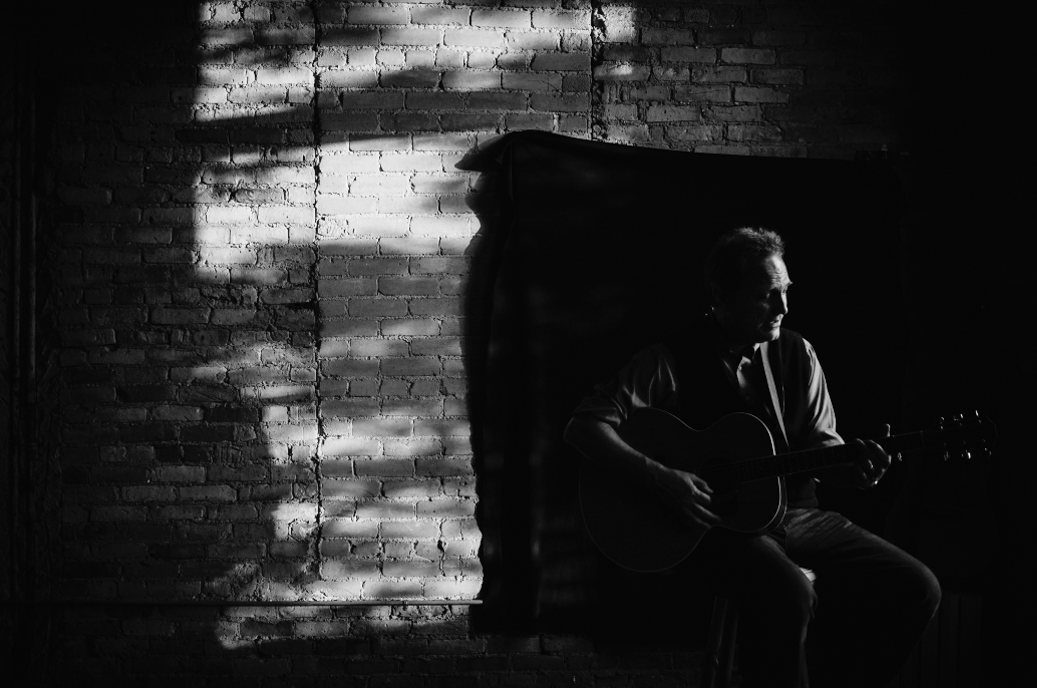
The conversation, the sharing of experience, the laughing and joking around. Remembering local history. Swapping stories. Sharing a complete and consuming love of music.
Last time, it was about art and creativity, about the Jackson market and the struggles of being a small-city artist.
This time, it’s a lot of same, except you swap paint brushes and cameras for guitars and microphones.
I’m launching my new community portrait project, Musicians In Jackson, on Kickstarter today.
A week ago, I kicked off the project at my studio open house. But this project has been in the works for almost a year now. I’ve thought and thought about it for so long, and now it’s a real thing in the world that I’m working on.
It involves capturing local Jackson, Michigan musicians on black and white medium format film through the summer. I’ll capture our conversations, make portraits, and share the creative love in my hometown.
Why Kickstarter? There are film costs, and the studio space to rent, and photographic prints to produce. It’s also a way to preorder prints or the book when it’s released this holiday season. Really, it’s a way to support creative endeavors like these community portrait projects.
“Just like any real human relationship, there are better looking, smarter, richer people out there,” says Olivier Duong. “But what really counts is what you do together.”
It’s such a strange way to think about buying a camera.
If I’m going to make an investment in a camera or lenses, I’m going to think about the lifespan of the equipment and how much work I can get done with it. Resale value doesn’t enter into the do-I-buy-it equation at all.
For me, I’d rather have a well-used camera that helps me make photographs than worry about selling it down the road.
The space isn’t big, and it’s not that easy to find.
But after Friday’s studio open house, I learned that the space is perfect for me and what I’m trying to do.
I had a good group of friends, family, and artists join me in the new studio space. We snacked, and drank, and made music, and made portraits. The kids had a good time exploring the workout room next door, while I had fun watching the light go from “wow” to “gorgeous” over the evening.
You know that feeling where you’re kind of dreading doing something, because of either fear, uncertainty, or doubt? And then once you start doing, those feelings fade away, and you say to yourself, “Yeah, this is totally doable?”
One of the large makers needs to step up to the plate and make a compact film camera. And I am not saying this on a whim or with a wistful idea of halcyon days. I get more requests for compact cameras than I could ever fulfill, even if I had the cameras. People are prepared to spend nearly $1000 for an old Contax or Ricoh, knowing full well that it could simply stop working at any point and there would be nothing they could do about it.
Hunt’s point – that the current stock of compact cameras is dwindling, and getting more expensive – tells me that there’s a market for a new film camera out there, if someone would just take a chance on making one. And with more and more companies investing in film again, photographers need new tools to take advantage of those film stocks.
Compact cameras are my favorite kind of camera, and I’m not alone. The company that stepped up and started making new film cameras again would gain more than money – they’d earn a whole bunch of goodwill.
Tomorrow night I’m hosting a studio open house in downtown Jackson.
It’s partly to kick off my next portrait project, partly to test out the new space, and partly as a big “thank you” to folks around town who have supported my projects. Plus I have a few people whose portrait I’ve wanted to make for a while now. So, bonus.
Coupled with a 50mm lens, it’s a great option for street shooting. It feels like shooting with a film camera in some respects. I’ve grown quite fond of mine again recently, and I’ve been shooting with it more and more lately.
“Like shooting with a film camera” – I get that, too, especially because all it does it shoot straight-up stills.
The Grind is the selecting your location, choosing which equipment to bring, selecting a film stock, lining up subjects, finding an open slot in your schedule, making time to send/respond to emails, editing the photos when you’re finished with the shoot, picking your favorite picture to present to the world, sending a select few to the subject, backing up your Lightroom library…
But that’s what “photography” means – it’s the photographs, and it’s the Grind to get them made.
Lately, it’s the Grind that has me feeling overwhelmed. If I can pick away at it, bit by bit, I do okay. Otherwise, I feel like I’m swimming in “photography.”
Better learn to love the Grind if you really want to accomplish that project.
Many thanks to my photo pal Jamie MacDonald (above, on one of our urbexing trips) for the questions, and to the Camera Mall for the post. They’re my go-to place for film purchasing and development here lately. It’s nice to have a retail location two blocks away from work here in Ann Arbor, Michigan.
Busting your ass planning something important? Feel like you can’t proceed until you have a bulletproof plan in place? Replace “plan” with “guess” and take it easy. That’s all plans really are anyway: guesses.
As my old boss used to say, plan the work and work the plan.
But I take the same approach to planning as I do for traveling: set up the ground rules and structure, and then let real life interject – as it always does.
I’ll admit that getting going with new creative projects has been a challenge lately. With the move, and the new baby, it’s been hard to think and plan about doing a big new thing.
“Inspiration,” as most people understand it, doesn’t help. I don’t need to look at other photo projects, or read quotes from famous artists. None of that will help me take a step forward. It’s not how I’m wired. Inspiration, for me, is just a bunch of ideas.
But this morning, on the drive into work, I felt a spark as I was listening to Bill and Jeffery on On Taking Pictures. It wasn’t anything concrete, or the subject matter, or even their mood. I think it was just listening to two people talk about art and creativity that made me feel better about my situation. That little creative fire inside me that’s been so weak the past few months got a little brighter. I can’t explain exactly how it lit back up, but I guess it doesn’t matter.
What I need is a kick in the butt from time to time, not inspiration.
All of my photographs during the year just “happened”. Nothing was planned in advance. I was able to capture them just because I brought my camera with me everywhere, every single day. And sometimes, because I felt brave enough to ask a complete stranger for their portrait, and I didn’t get chased away.
Planned versus unplanned. Project versus un-project.
This idea of the 365 project keeps coming up, because I’m starting to see it as a worthwhile challenge to any creative person. “Discipline and constant work at the whetstones upon which the dull knife of talent is honed,” says Stephen King. Keeping at something, day after day, is intrinsically rewarding.
But what about a planned project versus a project like Patience’s? Bill Wadman, for instance, is doing 365 portraits this year. It’s a project with a set of restrictions: pictures of people, with Wadman’s new-ish medium format camera. There’s a schedule to set and people to line up. There’s structure.
Patience’s project – “capture real moments and make memories, to tell about the good and the bad times” – is a rambling, take-it-as-you-get-it 365 project. He takes the world, day to day, exactly as it is, and lets chaos and randomness dictate his project. Apart from one camera, one lens, one film, there’s very little structure.
My preference? One of each, which is my goal this year.
We wait all winter for days like this: sunny, decently warm, fresh breeze blowing.
In our new neighborhood, we’re surrounded by parks and playgrounds. Sparks Park – kind of Jackson’s own Central Park – is a block or two away, and we have several schools in the street next to ours, lousy with playground equipment. Our old neighborhood was very walkable, but it’s nice being so close to all this fun.
Now, when we go on walks around the neighborhood, the kids beg to go to one of the playgrounds. I have a feeling we’ll spend a lot of time here.
And that’s great. For today, we’re just happy to be outside.
Don’t be creepy. Don’t be a jerk. Don’t waste people’s time. Don’t ask too much. And don’t ever ever ask people to follow you. “Follow me back?” is the saddest question on the Internet.
As true for marketing pros as it is for artists. Maybe especially.
I didn’t plan on being a marketing/communications professional, but that’s how things worked out after college. Originally trained as a journalist, I used my liberal arts background and interests to become a little-bit-of-everything marketing pro. As long as I’m making things, I’m happy.
Journalism is probably where I get my skepticism of most things marketing. For a marketing professional, I don’t actually subscribe to a lot of marketing tricks. If it annoys me, as a user/customer, I can be sure it’ll annoy someone on the receiving end. So, I tend to not use marketing techniques that are onerous to the end user. No digital ads that follow you around, no cover-the-whole-page-in-an-ad news site takeovers, nothing that screams for attention.
Again: if it bothers me, why would I do it to someone else?
Klein’s advice is the simplest, bare minimum marketing advice I can share. Don’t be that marketing pro.
Landscape photography is healthy. You hike miles. You look at gorgeous things. It feels good. It makes others looking at the results feel good too. Few things create such positive results for all involved.
Amen. As always, photography can serve as the excuse to do something you already love.
Steve Gray comes from a world a way, and captures his landscape and surroundings in a lovely way. I first learned about Steve through his Borderland project, but I’m recently digging his Postcards from Cambridge, MA series.
Where are you and what do you do?
I am based in the county of Herefordshire in the west of England, close to the border with Wales. It is a region of rolling farmland, wooded hills and (close to the border) dramatic upland moor. I am very fond of this landscape and it features a lot in my photography. My initial interest photographically was in taking what I guess you could call a traditional approach, working slowly with a tripod, using filters and trying to be out in dramatic light and the start and end of the day. I soon realised thought that this wasn’t really for me and latterly I have pursued a more contemporary, documentary approach to my work (always handheld these days!) – whether shooting in an urban or rural environment.
How did you get started in photography?
My interest led me to enroll in a beginners black and white darkroom evening class back in 2003. I knew next to nothing about photographic technique and so it was a pretty steep learning curve. Very quickly, however, I knew that I was hooked and photography has been a huge part of my life ever since.
What do you like about your photography?
It has taken many years of experimentation and many failed images and projects for me to feel comfortable with my own work, but I’m happy to say I now do. I think it is really important to develop an approach and style that works for you, produce images that make you happy and not worry if others like them too. That said, I do really enjoy sharing my work and hope that some of my images create a positive reaction. If pushed, I guess I would say I like the freedom in my approach to image-making – I work quite spontaneously with little planning. I’m also very partial to photograph patterns, shadows and shapes I find interesting. Lastly, it really appeals to me to have such a personal means by which to share how I see the world around me.
I like that your work explores different locations. Where do you get inspiration for your style/ideas?
My local landscape is definitely a source of inspiration. I believe the best approach is to photography what’s around you, what you know or where you happen to be, and try to find ways to make interesting pictures. This is in contrast to the trend to travel to well-known and much-photographed beauty spots. I’m not criticising that approach, I’ve simply come to realise it’s not for me and doesn’t produce results I feel happy with.
You’re “Yashica Steve” on Instagram – using film to express your vision. What kinds of themes do you explore with your work? How does film help you accomplish that?
I set up my Instagram account as @yashicasteve to share new film work when I started working with film again last year. I have really loved photographing this way over the last few months, using a Yashica T4 35mm compact camera loaded with AgfaVista 200. I’m don’t support the notion that film is better than digital (or vice versa), it’s just that I find the feel of the pictures, the atmosphere, really pleasing and it seems to suit my preferred subject matter. I am increasingly enjoying walking around urban environments with no planned route or expectations and simply photographing things I encounter that interest me. I also love the deferred gratification of seeing the images after getting the film developed – digital has made everything so instantaneous this is a real pleasure!
Any upcoming projects or shoots you’re working on?
My focus over recent months has been on a project called Borderland: where England meets Wales, documenting the often forgotten rural hinterland I call home on the border between the two countries. The landscape there is changing in many ways as (very slowly!) this rural landscape modernises and traditional ways of life decline. I think it makes for a fascinating and timely subject and I’m hoping others agree! I have managed all aspects of putting the book together and promoting it myself and am delighted to have sold most of the limited edition of 100 copies. There are some still available, however, and the whole series can be viewed and orders placed on my website.
Reminders basically rule my life. Since my first iPhone, I’ve let a combination of to-do tasks and calendar pop-ups tell me what to do, and when. Everything from taking my daily medication to taking out the trash – I assign a robot to tell me things that I would otherwise forget. It’s a mix of Absent-Minded Professorness and outboard brain reliance.
I know that if I want to build a habit (exercise), or tell myself to do something later in a day (call the cable company), or if there’s something I just can’t or shouldn’t forget (a doctor’s appointment), I have to set a reminder. Otherwise, my brain won’t hold on to the information.
Now, I’m using a reminder system to keep my daily project going. It’s simple: twice a day, Day One tells me to make a new entry. That’s my signal to keep my photo project going – usually at 4 p.m. (before I leave work) and 7 p.m. (before the light disappears).
Why Day One? For me, it serves as both a reminder system and a daily log for the photo I take and the camera settings I used. I can even include a reference photo as a visual clue.
Day One has served me well since the birth of my daughter in 2015. Then, I used it as a journal to record her growing up – personality developments, funny sayings, a photo, that kind of thing. It came in handy when I made her first year photo book; I could look back and see, chronologically, how she was turning into a toddler.
The app doesn’t really matter. You could do something similar with a calendar or a text file. The point is that I rely so much on reminders that I’m using them to keep my daily photo project moving along. I’m both reminding myself and logging my progress as I go. Over time, it may become a habit, and I won’t need to think about it.
But probably not. I know myself well enough to keep a system like this in place until the project is done.