World Moves Forward

Harbor Springs, Michigan

November so far here in Michigan has been rare and lovely: mid 60s, sunny, and the leaves have held on for what seems to be a longer time.
But then there’s all the weirdness in my life right now: the whole family has been sick, we’re trying to sell our house, the election. To top it off, yesterday our water well pump gave up the ghost – while I was in the shower, with shampoo still in my hair, no less.
That’s life, right? The good and the bad. The strange and the secure. Everything is in transition.
Luckily, the nicer weather means more chances to make photographs. I took the boy to an area nature preserve yesterday for some hiking, just to get out in the woods. My wife picked up a bushel of random apples yesterday, so I may do a little still life project around that.
Strange November. It may get even stranger tomorrow night. Make sure you get out and vote.


The fall colors this year have been a lot of fun to watch, especially here on campus. So I couldn’t let a little thing like a rainy day stop me from wandering and grabbing a few images.
Orange, yellow, green, muddy browns – all the October colors were there. Although the rain would knock many of the more colorful leaves down.
I haven’t had the time or energy to get out and take autumn photos like I’ve wanted to. We had the weekend up north, and lots of Halloween fun, but I feel like I’ve watched this autumn pass by. Thankfully, an umbrella makes dreary day image making possible.

In Sound City, Dave Grohl’s love letter to the legendary, hit-making studio in California, he and other musicians gush about the “real” process of getting guys in a studio and recording music live, on two-inch tape: “the human element of creating and recording music.” ProTools has its place, many of the artists say, but there’s nothing like analog.
We’ve heard this before, of course. Everyone from filmmakers to photographers are returning to (or, in the case of movies, never leaving) film.
Lots of words get used to describe this process: magic, alchemy, mystery, human. Digital is too “easy.” You can fix everything with digital. Etc.
For many, it’s a return to what is known. Analog is more familiar to those of a certain age. A lot of what Grohl and Christopher Nolan and other film fans seem to be saying is, “You missed the good stuff, the good old days.”
Those of us who adopted photography as a hobby or profession in the digital age don’t know what a dark room is like because we’ve never used one, and may never step foot in one.
(A side note: my college newspaper had a darkroom attached to it, behind this sweet swiveling circular door, and I did spend some time in there – but never to actually develop or print images. I remember photography students spending a lot of time in that room, and I’d catch glimpses of what they were working on when they brought their prints out into the light.)
We seemed to have this big upswing, in the ’80s (music), ’90s (movies), and 2000s (photography) toward digital art making. In the last decade, that digital tide has swung back, and more and more artists are experimenting with analog again. Call it the Maker Movement, call it hipsterism, call it whatever, but vinyl records and photo film seem to be doing okay again. Not great, but not dead.
So it is with blogging – away from federated, silo’d social media platforms and toward artists and writers owning their material.
Maybe we’re all learning that perfect isn’t the goal. The goal is to make something great, imperfections and all. Something human.
We’re all living in Analog City now.


On the first of October last year, I took a walk in the Whitehouse Nature Center in Albion, Michigan. It was a beautiful fall day, one that only hinted at the darkness to come. The leaves were just starting to fall, and I wanted to play with the light and see what I could capture.
This what I came up with – edited and processed more than a full year later.
I’m doing this more and more: letting projects sit for a while, and then addressing them months (or a year) later to see what sticks out, creatively. For these leaves, I knew I wanted to let them marinate for a while.
Here’s to the last days of October.


Last weekend we traveled up to Harbor Springs, Michigan—a beautiful little bayside town along the Little Traverse Bay, on Lake Michigan—to visit family for a birthday party. These little weekend vacations are a nice, quick getaway. We need a distraction from selling the house, and who can say “no” to northern Michigan?
The autumn colors were gorgeous, of course, but so was the light coming in from the big living room window. It’s one of my favorite situations to shoot in; we’re lucky enough to have a big window in our living room back home.
But for this weekend, with all the cousins playing together and quiet fall mornings spent sketching or watching the game, we soaked up all the light and seasonal spirit we could.

I’ve been enjoying the heck out of Rebecca Lily’s (of that fame) 365 project blog. It’s a lovely mix of daily images and journaling.
But it got me thinking: what if you did a 365 day photo project and didn’t share the output with anyone?
No blog, no social media, no nothing – just kept all those images to yourself.
Now, what if you took those photos and made a photo book, but only shared it with someone you love or admire? One person, one copy.
Or what if you created a photo book and only printed a copy for yourself?
As artists, hobbyists, and professionals, sometimes we feel the need to share everything we do. But what if you made something just for you? Would you still do it? Would it still be worth doing?


About a year and a half ago, I had a crazy idea for a portrait project: Gather up some of the talented artists in my hometown of Jackson, Michigan, take their portrait, and share their story.
It took time, and thinking, and a bit of bravery, but last June I started to reach out to local artists and introduce myself. For many of them, it must have been weird to get an email from a random guy saying he wanted to take their picture.
Remarkably, I received very few “no thanks” replies. There were a few artists who couldn’t make the time, or life circumstances got in the way, but overwhelmingly everyone I talked to was up for it – if a little confused about what the project was about.
So one by one, person by person, I built a subject list. I started with people I knew (thanks Cassandra!), introduced myself at local art festivals, and got in touch with art collectives in the area. I discovered artists and their art.
That’s how I built Artists In Jackson.
It was a long game. I knew it was going to take months, and it ended up taking me well into the fall to photograph everyone. Then I had to transcribe the interviews, edit the photos, write the profiles, and design the book. It was a lot of work. And this was after having a brand new baby!
But here I am, one year after the launch, and everything fell into place. My first show at Sandhill Crane Vineyards was a big success (above), and we had another group show at Art 634. Two shows, two months – two opportunities to show off my project and the talented artists. Maybe even help out the artistic economy in town.
I’m super grateful for all the support I’ve received from my community. I feel like the hard work I put in has been worth it, that I’m getting these artists out in front of people, and that big, ambitious projects like this are important.
Artists In Jackson has helped me think differently about my photography. I’ve learned that photography can be a great way to meet new people, and to give back to the community.
And as a “maker” of stuff, it’s been so rewarding to make the photos, write the stories, and produce the book. It all tickles that “joy” part of my brain: I made something that people purchase and read and hang on their walls.
It’s super satisfying.
Last March I had an idea: what if the artistic community in Jackson got together and threw a big social media party – an advocacy and awareness campaign to promote arts and culture around the county. That idea came to fruition, and today is the day, thanks to my colleagues at the Arts and Cultural Alliance.
Happy Arts In Jackson Day, everyone.

Michael Dees guest writing at Eric Kim’s blog, speaking my kind of language:
There’s an inherent mysteriousness in shadows. With shadows there seems to be a disclosure of sorts, but not the full story. Thus, imagination is kicked in gear, and the viewer is invited to complete a fitting story.
…Not only is there ambiguity and unfinished story embedded in every shadow, but often, a visual leading of the eye to the subject proper.
The whole essay is great, as are the images, but the above passage is the nut. It’s what draws me to take photos of shadows – of slices of light and darkness.
I’ve trained myself so that most of what I see is in terms of where the shadows are. Shadows are the reason I’m so against HDR photography (especially in urbex situations).
Why not leave a little mystery? Why not let the viewer participate in the story?


One of the benefits of living where we live: two orchards five minutes away, out in the southern Michigan countryside.
The seasons come, the rhythm of life beats on, and every year we visit these places to take part in these family rituals. Cider and donuts, apples, fresh produce (squash season!), and picking out pumpkins.
Adams Farm is the closest to our house. It’s less touristy than the other place, farther down the road, and that means less people, less noise, less hornets. This is where we come to grab our pumpkins – a big green field full of orange.
Soon, this place will be a longer drive away. So we soak up all the pastoral goodness we can now, while the season is right.
Remember what I said about investing in the art you enjoy?
Photographer Jon Wilkening is doing a 365 day project, where he offers up a print each day – and it costs whatever order it’s in. I got day number eight, so I paid $8. Day number 365 will be $365, etc.
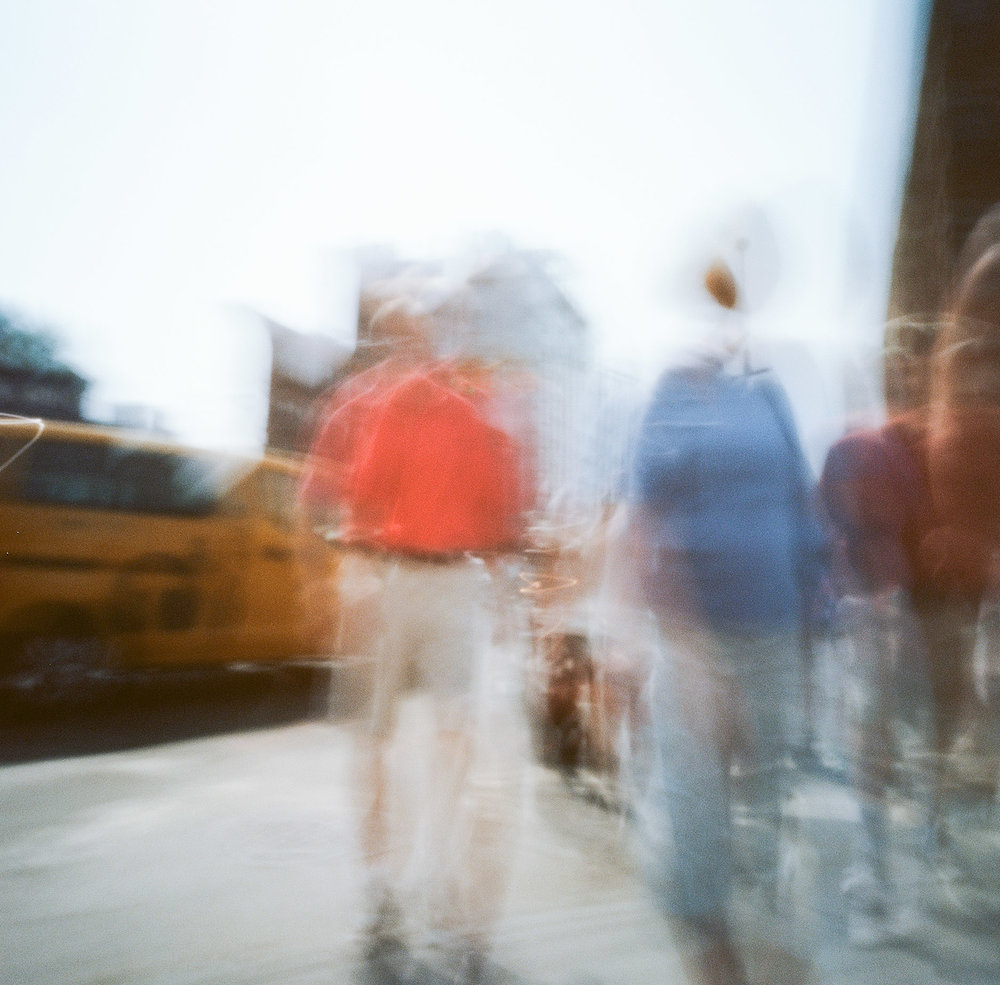
Jon’s work is very cool. He does pinhole street photography, with interesting motion and abstract blurs. I waited for the right combination of light and colors for my print, and day eight has this lovely primary color scheme going on.
Order one of Jon’s prints – they’re great.

My family took a short vacation to northern Michigan over the weekend to visit family. On the way back, as I usually do, I made it a point to stop at the little towns along the way and grab a few photographs.
Capturing small towns in Michigan is long, ongoing project of mine. I find the sights of these little communities so fascinating. And it highlights the benefit of getting off the interstate highway system and travel the two-lane highways all across the countryside. It’s on these little side trips that you see the memorable stuff. There’s space, time, and a lack of traffic that makes pulling over easier, too.
Making photos of these small towns is almost an archeological exercise for me. I feel like I need to capture the quirks and personalities of these towns and villages before they disappear. Or in case I never come back.

Since January, I’ve been working on a modest fitness goal: lose 10 pounds and start working out regularly again.
So far, so good. I’m down eight pounds, thanks to a combination of healthy eating and exercise, and I hope to reach my goal before the holidays (when I’ll really need to work on my discipline!).
Part of the program involves photography. Landscape, nature, and street photographers already know this, but including photography in your fitness plan is easy. You walk, you shoot, you get some fresh air – each thing reinforces the other. Heading out to shoot is a great excuse to get some exercise.
So that’s what I’ve done. I’ve made it a point to head out, especially during my lunch hours at work, and take a long walk, camera in tow.
The result has been a ton of new street photography experiments. Getting out and exploring Ann Arbor has been a lot of fun. And after a summer of getting outside, I’m really noticing the benefits.
A few tips:
Win-win, right? Fresh air, slimmer waistline, and an excuse to make photographs.

What I’ll miss about moving closer to the city? This.
It’s something I’ve learned while we’ve been out house hunting: I need trees, green space, a sense of privacy, nature, birds chirping, and clear seasonal changes.
I need to feel like the woods are only a short walk away. That there’ll be foggy fields on my way into work. That my home will be well shaded by trees.
I need light filtering through branches and boughs.

If I were to give one piece of advice, it’s to study light. Study it in everyday life. Pay attention to its properties and how it behaves. See how it changes after the sun dips below the horizon but it’s still not dark. See what it does when it bounces off a white wall, or wraps around a black sphere, or morning light shines through the hair of someone you love. Then capture it with whatever camera you have.
Light. It’s all that matters. If you’re not a student of light, you’re barely a student of photography.
Celebrate light.
And celebrate the people, places, and ideas that you love.

There’s value in returning to the same places or subjects over and over again. In time, you watch the place change, grow, or deteriorate as your own skills develop.
The Irish Hills of Michigan has become my go-to spot, over and over again, for years now. My fascination with the place comes from childhood: I grew up and around the area, and visited the local amusement parks often. It’s also a gorgeous place, full of rolling hills and secluded lakes, and located along the US-12 corridor west of Detroit.
Lately, I’ve driven US-12 on my work commute, which is much more my style – no freeway, no stop-and-go-traffic, etc. And each day I drive the route, I think, “This is the place I want to focus my creative attention.”
There are plenty of project opportunities in a diversity of settings in the Irish Hills. It already has been my focus for a few years now. But lately, I find that I keep coming back to the place. I did just that this past weekend, revisiting some old haunts and scoping out some new ones.

Transatlantic, “All of the Above“:
When October winds lay down,
When the heat can’t melt the ground,
And nothing matters anyway.
When October winds take hold,
And you’re down that dank, dark road,
Maybe nothing matters anyway.
Taken about a year ago on my morning commute.
Miss my country backroads so much.

Chris Gampat at the Phoblographer on the unique look of older CCD camera sensors:
CCD sensors on the other hand were really a work of art. They delivered great images, but at high ISOs they just fell apart. Arguably though, you’d get even better colors with one when paired with more modern glass. CCD sensors also delivered images that simply just looked organic and film-like. You generally didn’t need to apply some filter from VSCO or RNI films, you just got it.
Embrace the old school – the flaws, the imperfections, the personality, the challenges. With film, it was easy: grab a camera and buy a pack of film. But with digital, there are only so many limitations, and one of those is the older-style digital sensor format.
Maybe CCD sensors will be the new Lomography for the digital crowd.

This time last year, I was knee-deep in working on my documentary, Albion Anagama.
I learned a lot during the making of that film – about ceramics, and artistic process, and teamwork.
I also learned the value of a dedicated space to do creative work. In this instance, Ken built a fabulous studio on the outskirts of Albion, Michigan, complete with kilns and a garden and lots of space. He and his team had just about everything they needed to do work right there, from music to materials.
The idea of a dedicated work area appeals to me. In my recent house-hunting sojourns, it’s fun to see a basement workshop, or a dark room custom built for a film photographer. Even a simple office works.
At work, I find that taking my laptop and going somewhere fresh and new is a good kick in the butt to get work done. It’s not dedicated space, but it is a new space – and that helps me get some things accomplished.

During Artists In Jackson, my portrait strategy for each artist was a mix of planning and spontaneity.
Take Ashley here. My thinking going into our sessions was: pick a cool spot, a good time of day, and see what we make.
Others, like Andrew, I didn’t know the location at all, but as we explored the building we found a room with just my kind of light.
My trick is to find a location that has what Brooks Jensen calls a “density of opportunity.” Namely, head to a place I know reasonably well, with cool surroundings, that we can use to make photos. And typically, I try to find a time of day where light comes in at an angle, and I can have fun with shadows or golden hour.
Otherwise, I’m making it up as I go along. And that’s part of the fun, and the learning. Those variables feel comfortable.
That may be why I’m having such a hard time getting started on my next portrait project. This time, my thinking is to have everyone come to one location, with a structured light source, and shoot on a simple backdrop with simple surroundings. There’s no improv involved with the settings, lighting, etc. The only variable is the subject of the portrait – that’s where the chaos comes in.
With such a rigid structure, I feel like everything—the place, the time, the light—has to be perfect before I even get started making photographs. So I haven’t started.
Given enough time, that Not Starting turns into guilt (for not making) and worry (about never starting), and that’s where I sit right now.

“Make things for people you love.” – Austin Kleon
Robert Mapplethorpe gave a lot of his work away to friends. So did Picasso (to some controversy).
These were some of the most famous artists of their time, and now their work goes for thousands of dollars. The people who loved and supported them get the benefit.
So it should be with the work we make.
My guess is that there are people in your life—family, spouses, friends, supporters—who help to make your art possible, either through emotional support or hustle. It’s certainly true for me. For my recent gallery shows, it’s always my friends and family who turn out. That support means a lot.
I feel like we should be generous with our art, especially to those who show up. A print doesn’t cost that much to make – why not gift it to someone who loves your work?
Recently, my in-laws asked if they could get a few of my still life prints to go with their dining room remodel. I gladly two photos to go with their decoration scheme, no questions asked.
I’m never going to be famous like Mapplethorpe, and my work will never sell for thousands of dollars. But even if it did, giving my work away to people I care about is the least I can do for their time and attention.