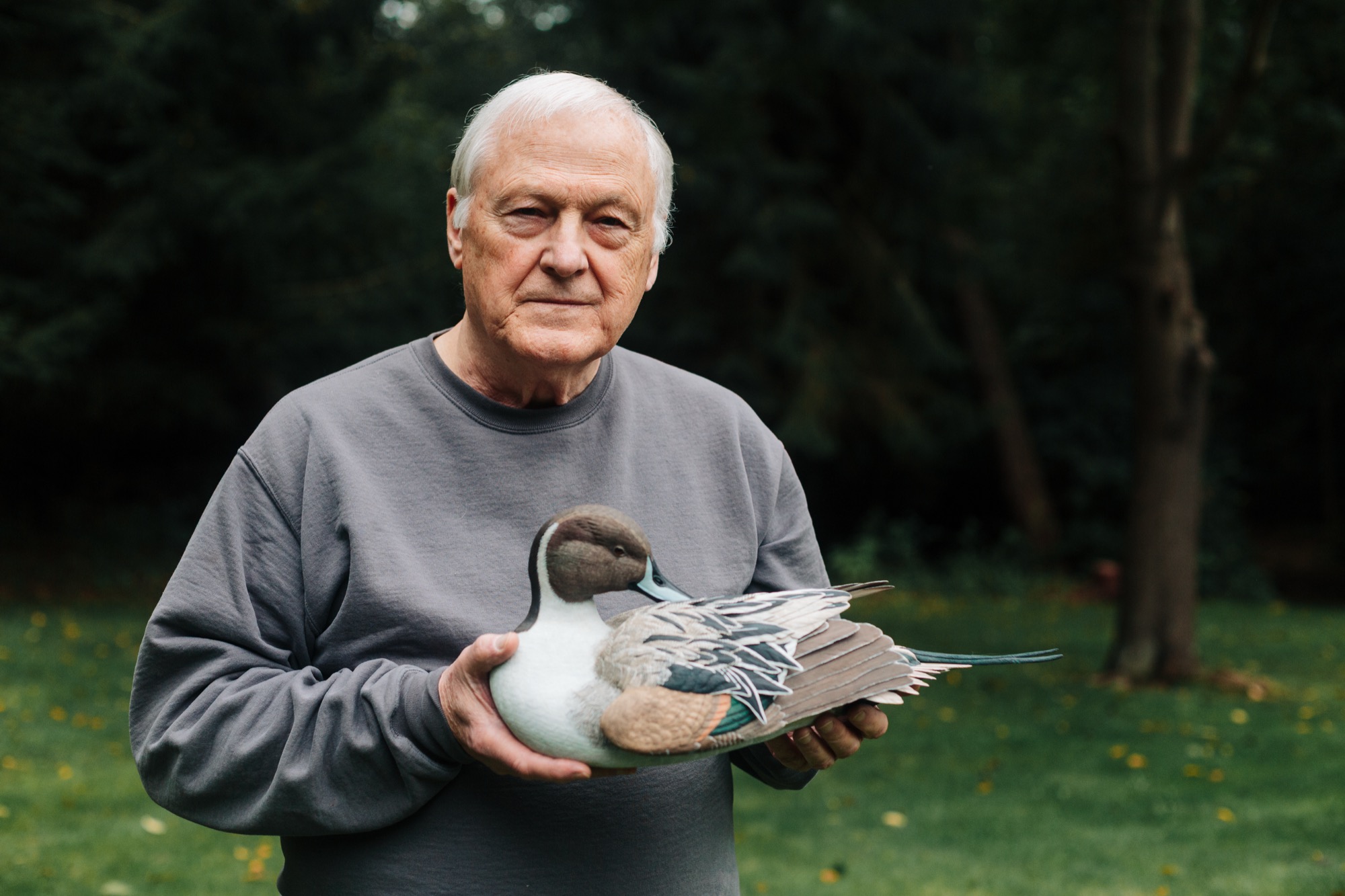
Artists In Jackson: John Blank
For 17 years, a carved but unfinished basswood duck sat in John Blank’s basement workshop.
Every time he walked into the room, he saw it. The blank had been cut out years earlier, and John always meant to get back to it. He just got interested in other things: Deer. Sheep. Elk. Bison. Commissions. Painting. New challenges.
One day he looked at the unfinished duck again.
“It’s just waiting,” John says. “I kept looking, and finally one day I thought, ‘I have to carve it.’”
That duck became the first bird he had carved in 17 years. Ducks are where all of this started for John.


The Long Way Around
Blank’s first art supplies arrived one Christmas when his parents bought him a giant roll of paper.
“You just pulled it out of the box and drew on it,” he said.
At Parkside, a high school at the time, John’s art teacher saw something in him. “John, you need to stick with this,” the teacher told him. But life interrupted, as it often does.
He joined the Navy. Served aboard the aircraft carrier Enterprise in Vietnam. Married his high school sweetheart, Cheryl. Built a career in printing. Raised a family.
“I wish I had stuck with art,” he said. “Life kind of got in the way as I got older.”
Art never completely disappeared. He’d draw once in a while, or paint something now and then.
All the while, John had been interested in the outdoors. A local Ducks Unlimited collector connected him with Hans Bolte, a respected carver from Troy, Michigan. In 1987, John spent weeks driving across the state to learn how to carve ducks from him.
After the class ended, John finished carving and painting a canvasback duck and drove it back to Troy to show his instructor. It was so good that Bolte asked why he didn’t enter it in a world competition.
Blank had no idea what he meant, but Bolte’s question introduced John to the wider world of wood carving.

In the Workshop
John’s basement workshop holds all his tools and materials, and shelves filled with birds and half-finished projects.
It’s not much, but it’s cozy and gives him a place to work on his creative projects in peace.
Nearly every one of his carvings started here – animals from the swamps of Louisiana to the mountains of Canada. It’s his way of showing appreciation for the natural world.
Over the years, his work has paid for hunting trips, helped to purchase vehicles, covered bills, and funded the entire studio. The Danbury Mint even reproduced and sold three of his deer carvings, and his work has been sold at Cabela’s Dundee, Michigan store and through North America Hunter magazine.
“I’m very proud of that,” John says. “My art has paid for itself literally from day one.”


Today, in retirement, he moves back and forth between carving and painting. A painting might take a couple of weeks while a carved duck can require more than 120 hours.
“I go back and forth now, between carving and painting,” John says. “If this isn’t working, that doesn’t mean painting won’t. I can go in there and maybe painting is working. So fine, I’ll do that.”
All that creativity keeps him busy now that he doesn’t work full time. The duck that sat untouched for 17 years is finished now, but there’s another one sitting on the bench – ready when John is.
His favorite part? The detail work.
“It’ll take 20 hours to burn this feather detail,” John says, pointing to the fine lines on a piece. “That’s what I love doing. Because I love detail.”
Escape and Priorities
 At 79, John appreciates the good days. Nerve damage connected to his Navy service can make working difficult.
When he’s feeling well, he heads downstairs to his workshop to shut everything else off for a while.
“I’m in another world down here,” he says. “Upstairs doesn’t exist. When it’s working, I don’t want to stop.”
John’s learned the opposite lesson, too: walk away and come back when inspiration strikes again.
That instinct took years to develop. Earlier in life, he’d keep pushing through and keep working, only to come back the next morning and wish he’d stopped sooner. Now he knows better.
John doesn’t think much about his artistic legacy – his wife and grandkids are the priorities in his life now – but he still takes pride in his work.
“When I know people appreciate what I’m doing, and they say ‘I’ve got to have one of John’s birds,’ that means a lot to me,” he says.
Visit John Blank's Facebook page