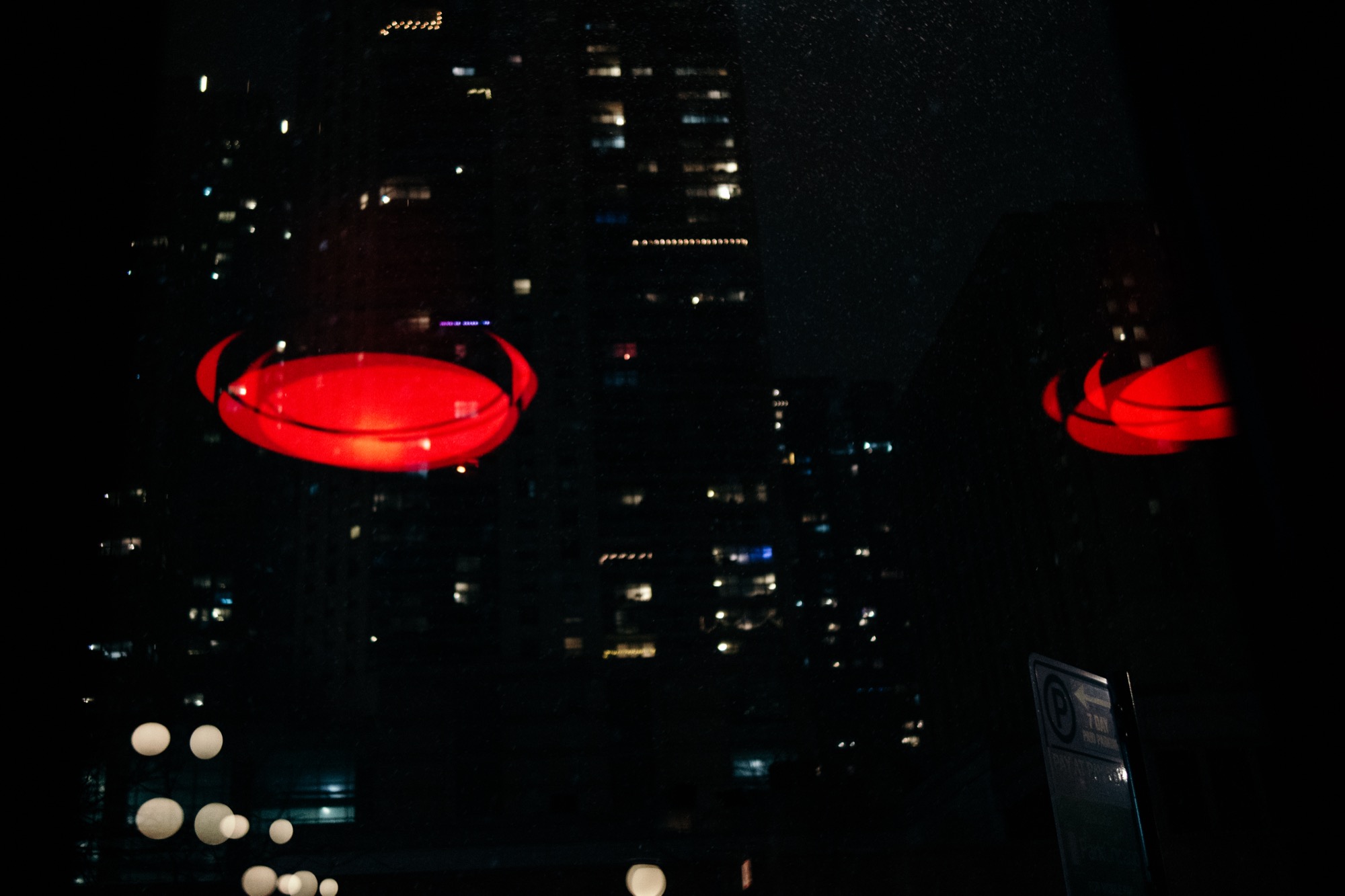
We had the weekend in Chicago – just the two of us, two whole days to make some good trouble.
My wife, Jaime, is starting to put herself out there as a business owner. She’s a music therapist, so many of her professional portraits feature a guitar of some sort.
With her new enterprise, she wanted some professional images without an instrument.
So we wandered around Chicago’s loop, walked inside some boutique hotel lobbies, and made some headshots before we got kicked out.
And it was fun. We felt like two teenagers who, at any moment, were going to get caught somewhere they shouldn’t have been.
There was one high-end luxury hotel in particular where I felt the lobby desk’s eyes were on us. But in each location, nothing happened. We got off scot-free.
The photos? They were just what Jaime was looking for – wardobe changes and all.
If there’s a lesson here, it’s that you should use your photography superpowers to help people, especially people you know and love.
Take them up on their creative idea. You might have a great time doing it.
All images shot on the Canon EOS M6 and a few EF-M lenses.
This time, we were in town for the weekend to see Brandi Carlile and, the next day, wander into downtown Chicago for some new headshots for my wife (more on those later).
Wandering the streets around The Loop, I couldn’t help but grab some pictures.
All images shot on the Canon EOS M6 and a few EF-M lenses.
Think of Baixa as a easily-navigable shopping district. The busy neighborhood follows a clean grid layout, making it feel open, orderly, and walkable.
There were a few hills, but none of the steep ones we had just toured around in the Alfama district.
And in the middle of the day, the bright sun lit up the place, casting perfect shadows on the buildings and pedestrians as we walked around.
All of this – the buildings, the sunlight, and people wandering around – made for perfect street photography conditions. It fit my style, and I took full advantage.
After taking some of these photos, I caught my breath. I was in picture heaven.
This lady, watching me take photos on the busy walkway, came up to me and started singing. Lovely!
We made our way down to the Rua Augusta to the Arco da Rua Augusta, in view of the Tagus River, then back up to the Hotel do Chiado, where we grabbed lunch at their rooftop bar.
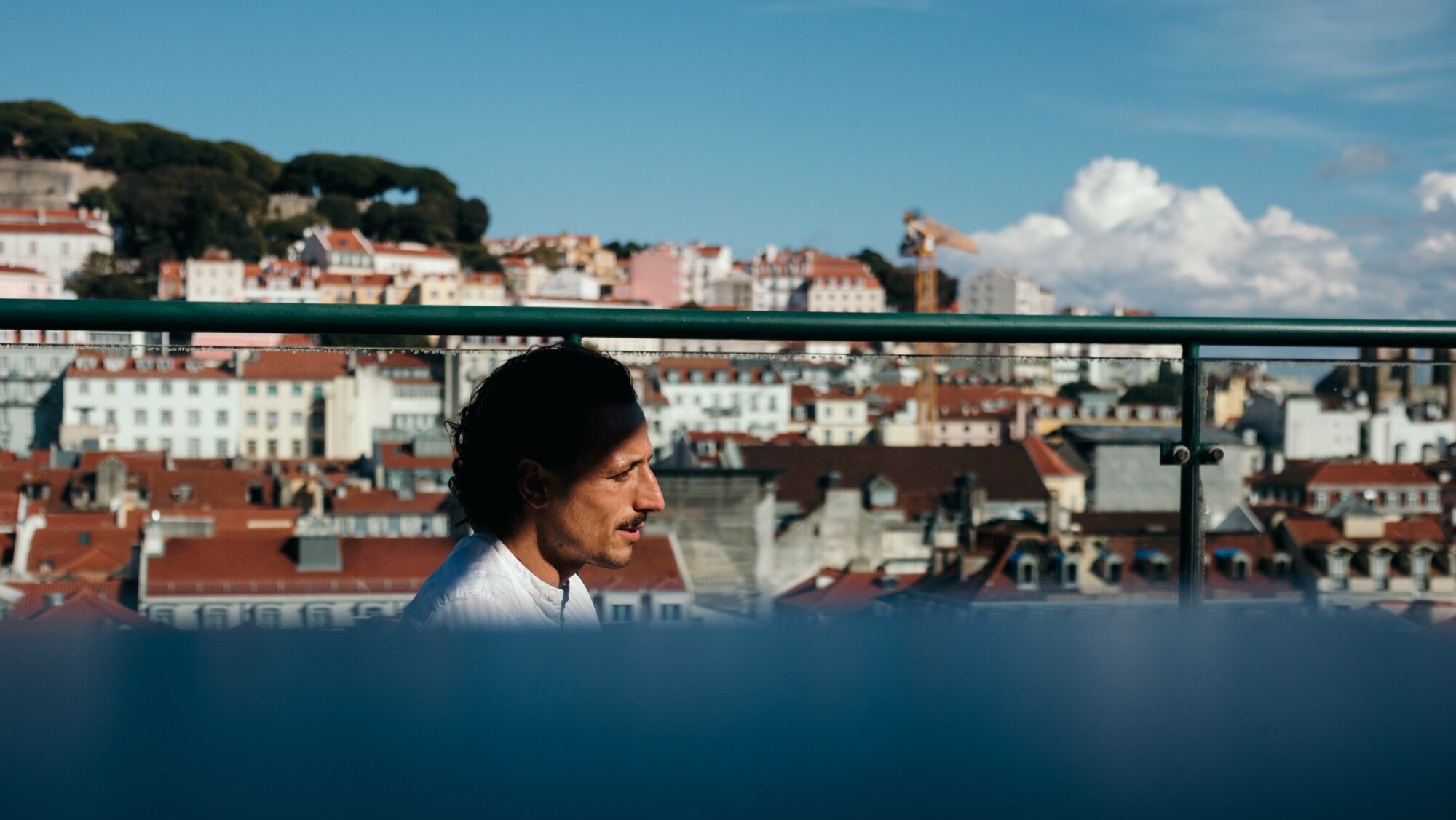
It was here that I grabbed what might be my favorite photo series from the whole trip.
Across from our table was this very animated Frenchman talking business with a local. The way the shadows and light fell across him made for a beautiful scene – so much so that I couldn’t stop making photos. Luckily, he didn’t seem to notice.
That night, we finished up our trip with a sailboat ride on the Tagus River.
Shot on the Canon EOS M6 and (mostly) the EF-M 32mm f/1.4.
My family and I are participating in our local theatre production of The Full Monty.
When our family performed in Chitty Chitty Bang Bang in 2023, I was an observer as my wife and two girls starred in the show. This time, I joined the team as an ensemble member.
For our rehearsals, I asked for special permission to bring my camera and capture some behind-the-scenes pictures. These BHS shots are often my favorite kinds of photos. I feel like I would’ve been a great on-set movie photographer.
This is also a way I can give back to the production without working on the set, or the market plan, or having a starring role. By taking photos, I can capture the process. Along the way, the cast and crew can see how the show becomes The Show.
Throughout the month of rehearsals, I snagged hundreds of photos. Here are my 10 favorites and why I appreciate them so much.
#10: First Day of Rehearsal
I walked into the church basement, where we would live for weeks fleshing out the show, and was immediately caught by the light streaming in the sliding-glass window. This was a good sign: good, dramatic light. I knew I had a good situation to create interesting photos.
#9: View from the Stage
In the church where we rehearse, there is a stage where we don’t rehearse – which I think is kind of funny. Maybe it’s too small. But anyway, here’s a view from that stage as we practice.
#8: Jaime Feeling It
My wife, Jaime, is feeling something here. It was a fun moment to capture as the other actors read their lines.
#7: Contacts for Harold
Vicki (played by my wife, Jaime) and Harold are my favorite characters in The Full Monty. Initially, you see them as a materialistic couple that only cares about money, vacations, and displaying a false image of wealth and status. But soon you realize that they are deeply in love, and none of those material things matter. Here’s a moment where you see Vicki’s love for Harold in action, and it’s a hilarious moment in the musical.
#6: Makeup Time
Pure backstage goodness. Matt is our stage hand, and he plays a club owner in the musical – typical big, tough, handy guy. Here, he’s getting some makeup applied by his partner, Kris.
#5: The Boys
The six main characters of the show, here lined up on stage. I love how the negative space created by the shadow in front of the stage blacks out the entire theatre, leaving the focus on the guys with their hands raised.
#4: Reg In Light
Here, Tori looks like Bruce Wayne, barely in light, mostly in shadow. Tori was a frequent subject of photos because he’s such a character.
#3: Dressing Room
Before we got settled into the theater and backstage, I caught this quiet moment with Talon in the dressing room that I really like.
#2: Reg In Shadow
Like I said: Tori is a character, and here, that dynamic light in the church basement comes back into play. I fell in love with the light in our rehearsal space.
#1: Jerry In Repose
My favorite shot from rehearsals – this moment of quiet and rest from Talon, who plays Jerry, on the stage. It’s minimal, focused, and the contrast between Talon’s skin and the black stage floor is my kind of perfect.
I took a lot of photos during the process, and I’m very proud of the work. You can see more photos from our The Full Monty rehearsals on my Flickr profile.
BONUS: Horse Cracking Up
Allyn is a laugher, and I have a ton of him cracking up at some inappropriate comment. This one was my favorite 🙂
All photos were shot on the Canon EOS M6 with a variety of lenses.
After leaving Canada by way of New Brunswich and the border, we landed in Brooklin, Maine, our home for the next week.
We arrived at nightfall, so we had no glimpse of the peninsula where we sat.
Not until I got up early the first day and went to the beach.
This was the Maine I remember. And for that first morning, I had it all to myself.
I did what I always tend to do and went exploring – up and down the coastline, through the set of cabins on this part of the shore, taking advantage of the early morning light.
Then the family woke up, and we explored the jagged, rocky beach together.
The tide was a new thing for us Michiganders. Here on the peninsula, we had to pay attention: there were several islands you could walk out to at low tide. But come high tide, you might get stranded.
And the bay’s ocean water, just like in Nova Scotia, was freezing. So we mainly played on the rocks.
Later that night, after dinner, we took a stroll back down to the coast to watch blue hour come in at high tide.
Maine was different. More rugged. A little more wild. And there was lots more to see.
We managed to get away for our 10-year wedding anniversary.
It was chilly for the last weekend in May, but we returned to two of our favorite spots near the Lake Michigan coast: Virtue Cider in Fennville, Michigan, and The Kirby Hotel in Douglas, Michigan.
Virtue Cider
Virtue was one of my early “holy crap” ciders, where I took a chance on a six-pack of cans and was blown away.
Now we come back to taste the new ciders, grab a snack, and head outside for some acoustic guitar.
Kirby Hotel
We came to the Kirby on the coldest day of 2022, after the wassail celebration at Virtue Cider was cancelled because of the weather.
It was fine by us, because that winter, we had the place almost to ourselves and we got to chat with the chef and operator about their historic hotel.
This time, the house was packed for dinner, and we had several guests in the hotel. But the next morning, for breakfast? Just us and the chef again.
I love finding little places like this, where you become a regular and get to know the staff.
Shot on the Canon M6 and EF-M 22mm and 32mm lenses.
In my latest YouTube video, I test out several film-like Canon Picture Styles to see which of them can give Canon photographers that Fujifilm-like simulation experience.
Preslav Rachev left a comment asking for feedback on a Picture Style he recently developed, Cinematic Color Negative, and offered it up for a free trial.
Last weekend, I loaded up Preslav’s filmic emulation onto my Canon M6 and shot for an artist friend of mine at his Steampunk on the Bricks event here in Jackson, Michigan.
Overall? It’s good. I like the colors and contrast – it fits my style of shooting nicely.
The reds pop, and the greens are muted. That’s just what I’m looking for in my Canon film simulations. And in good lighting, skin tones are natural.
However, testing it out on our new baby niece, and in mixed lighting, the skin tones were a bit overpowering:
Everyone else’s skin tones looked okay, but poor Baby Iris. She got the neon orange treatment. It could be a combination of jaundice and a reddish skin hue.
The baby is an outlier. For the most part, Preslav’s Cinematic Color Negative Picture Style worked well over a weekend of shooting.
A few more RAW vs JPG shots for comparison (RAW is on the left):
My eye notes the subtle desaturation of the greens and blues. The top comparison makes that clear with the plants and the blue sky.
The bottom comparison is a little more subtle: contrast is up, and the house appears whiter in the JPG. Again, the sky in the back loses a bit of blue. Whites are whiter, blacks are blacker – both help increase the contrast.
Head to Gumroad, throw Preslav a buck or two, and try out Cinematic Color Negative yourself (and check out his photography too).
Here on Wildwood Ave and Edward St, behind the public high school, you can sense the age in the size of the homes and their proximity to downtown Jackson.
It’s quiet. A little under construction. And here on a sunny day in early May, there’s plenty to see.
It’s tough for me to make photos in cloudy conditions. I rely on sharp, dramatic sunlight for much of my work.
But here, on the northwest side of Jackson, Michigan, I gave it a good go around the Hibbard and Hallett Street neighborhood.
Instead of capturing light, I did my best to capture interesting settings, objects, or colors. If nothing else, it’s good for me to exercise the non-contrasty photography muscles.
When I worked close to an urban center – Ann Arbor and Albion, Michigan, for instance – exploring neighborhoods was a good way to get out, take a walk, and make photos of what I saw. I do it around my own neighborhood, too.
This style of photography reminds me of something William Eggleston would capture: the everyday life of an American town.
Lately, I’m making my way around local neighborhoods I don’t know well. This one, by the city’s primary high school, took me on streets I’ve never seen. I woke up early on a spring morning and took a walk to see what I could see.
Neighborhoods, with good light, are a constant source of good material. I could do this forever.
I try so hard to not be trendy. But here I am rucking around the neighborhood.
It is good exercise, and I walk all the time anyway.
As my joints ache, I notice that there’s a time of year, in the early spring, when the trees and bushes haven’t budded yet. At the edges of the day, in the morning and evening, the trees cast these stark, defined shadows on buildings.
I tried to think of a name for this phenomenon. The best I could do: bare limb shadows.
So we headed back to the hotel and just chilled. It wasn’t worth it outside.
Detroit Institute of arts
This was my jam.
The DIA is a world-class art museum, and the light was just perfect inside to get some dramatic shots inside the main hall and near the Diego Rivera mural.
After the museum, we ate at Hop Cat and watched the Detroit Qline come and go.
Heading home
A few more photos as we finish up at the hotel, have some diner-style breakfast, and head back to Jackson.
All images captured on a busted-ass Canon M6 and a variety of EF-M lenses.
I’m aiming to try out the popular film simulations for Canon cameras – like the well-known Fujifilm emulations on the X series cameras. While Canon cameras do not come with film emulations baked in, they are available via Canon’s Picture Style editor and camera profiles.
This Kodachrome-style film simulation comes from Cinescopophila: a giant pack of 150+ picture styles featuring a ton of favorites – almost too many to practically try out. But seeing Kodachrome on the list, I had to give it a spin on a recent family trip to Detroit.
Unlike the Fujifilm simulation from Thomas Fransson, these Kodak colors are more my vibe: warmer, much better skin tones, and a healthy amount of contrast.
And those reds? They POP. The greens are nice too. There’s none of that washed-out blandness from the Pro Neigh High series.
Overall, this is a reliable film simulation if you’re a JPG shooter or don’t want to worry about editing. Most of these came out correct as-is, with a little tinkering on a few images for exposure and contrast.
Do these photos mimic Kodachrome? Not really. But for my style of shooting, and even some video, these are a good film-like preset to get you started. With a bit of adjusting, you can get this slide film emulation looking just the way you want.
There are plenty of other Kodachrome versions to try, although many come at a cost. This picture style from Vision Wrangler comes with 150 more to try, with everything from wacky out-there stuff to tried-and-true black and white film emulations.
It’s true that I upgraded my original Canon M early last year with the Canon M200.
As the year went on and I used it more and more, a little itch in the back of my brain started. The itch, which weirdly has a voice, started saying, “Using this camera should be easier – and more fun, like your original Canon M was.”
What the itch said was also true.
Some of those true things included:
The M200 is not a customizable camera. You get what you get, no mods allowed.
I also missed the little handgrip bump on the front of the M. The M200 is as flat as Ohio
Last March, I said:
There aren’t many buttons or options, it’s not the toughest model, and you don’t have the in-the-hand control you have on a more advanced camera. But coming from the original M, the M200 felt at home in my hands.
“Trust your instincts,” the itch said, and there I was with this 2019-era mirrorless camera that did not bring me joy.
With all these truths in mind, I went back and looked to see if I could still upgrade to a Canon M6 mark II. The price was still high, and it still wasn’t widely available. That’s when my budget-friendly brain had an idea:
It doesn’t have all the modern bells and whistles of the mark II, but it does have:
Customizable buttons – and lots of them. The M6 has an almost Fuji-level amount of physical dials and buttons.
A physical button to recenter the focus point.
A wonderful hand grip on the front – more DSLR-style than a modest bump like the M had.
All the features of the M200: higher resolution, flippy screen, faster focus, etc.
And, little itch, the silver version looks kind of cool, cashing in on the retro silver-and-black look of film SLRs and rangefinders.
So that’s what I did: I purchased a refurbished Canon M6 and sold off my M200.
Here are some glamour shots with the EF-M 32mm f/1.4, taken on the Canon 5D and EF 100mm f/2.8 macro lens.
So far? I dig the M6. I love the improved ergonomics, retro styling, faster speed, and manual controls – especially the bumpy, knurled dials for aperture or ISO.
And it’s the perfect travel camera: light and easy to transport.
A few things I don’t love:
I do wish it had a viewfinder, even though I’m used to not having one on the M series. A rangefinder-style viewfinder would be so handy.
There’s a greenish/cyan tint to the files in Lightroom. I’m not sure if it’s the camera or Lightroom’s raw file handling, but I load up some files and they look icky.
Certain buttons on the camera drive me crazy: the touchscreen zoom button in the lower right and the physical manual focus button on the main dial. When I go to focus on a subject, the camera is unresponsive because I accidentally brushed that MF button. I turned it completely off in the custom settings.
Those quirks tell me that modern cameras, with so many hybrid demands put on them, are never perfect. My Canon 5D is perfect. Everything else has limitations or annoyances.
The above shot shows me using the M6 exclusively on a new photo project to learn my new camera.
This leads to the larger question about my camera strategy: what am I going to keep, and why do I need a different system than my EOS+EF system?
Mobility: I like the Canon M lineup’s weight and small size. It’s a perfect everyday carry and travel setup, including if I ever want to do some video.
Quality: Images are good, and the lenses make for sharp, pleasing photos.
Vibes: Since that first Canon M, I’ve admired the series, flawed though it is. It’s weird investing and tinkering with a dead mirrorless camera system, but I do love these little cameras.
With the M6, it’s so far, so good. This, combined with my old, clunky (but reliable) M as a backup, and I’ve got an old+new system similar to my Canon 5D plus 6D.
I brought the M6 with me to Austin, Texas, and Monterrey, Mexico. It served me well during the holidays and on random photo outings. It feels so much better in the hand.
I always want to do more night photography. Living in a small city, there’s not a lot of opportunity to grab night images like I’d like to.
Thanks to Austin, however, I had a great chance to tour around a decent-sized city to capture light, shadow, and color. My co-worker and I also stumbled on a commercial filming shoot taking place on 6th Street, near Voodoo Donuts, which provided an interesting behind-the-scenes view into a commercial production.
This night out inspired me so much that I thought, hey, Detroit’s not that far away. It might be worth a visit to get more of these kinds of photos.
The trip also inspired me to continue working on a long-term night photography project closer to home. More on that soon.
Here on the (other) Colorado River in Austin, Texas, it’s nothing but activity: boats taking tours up and down, joggers running past, couples getting their portraits taken.
Now we’re in the drab winter months, right before the holidays, and these photos – and this whole trip – make me miss the sunshine.
My conference hotel was on the south side of the river. A quick hop over and I was in downtown Austin.
The river made for a good orientation spot and a spectacular view.
One of my favorite kinds of street photography is to show up in a busy place where a bunch of people are gathered.
It’s probably a dash of event photography, and a splash of being somewhere where you know it’ll be busy.
And ’tis the season, right? So I stopped by St. Thomas the Apostle Catholic Church’s Christkindlmrkt – a European-style Christmas market with delicious German treats and lots of merriment. I had to do some Christmas shopping, and last year I visited a Christmas market in Ann Arbor and really enjoyed it. This year, I figured it’d be fun to try something new.
Knowing it may get pretty crowded, I brought along my Canon M6 and a few lenses. I snapped on the 22mm, 32mm, and 56mm on each consecutive lap around the church, opening up my aperture as it got darker.
Lots of kids, lots of families, and tons of gifts for Catholics. And all around, the smell of bratwurst on the grill. Perfect.
While the rain melted all the snow, and the temperature was getting warmer, it was still festive enough to feel the Christmas spirit – and enjoy a beer and a brat.
Here’s something I don’t usually do: some street photography around downtown Austin, Texas.
With all my work travels this year, I’ve had the chance to do more of this style of photography: Philadelphia, Mexico City, etc. And even with my recent practice, I still find it hard to do well.
But there’s nothing like practice. Austin’s perfect weather, manageable downtown, and good light all around helped.
One challenge was focal length. Either I wasn’t close enough, or my 22mm and 32mm on the Canon M6 didn’t get me close enough. Another challenge was traffic blocking some key shots.
Still, a good photowalk out and about, exploring the city.
Ali from One Month Two Cameras discusses her needs and wants for her everyday carry camera—the one you use for just about everything.
For 12 years, that was the Canon M for me. Earlier this year, I upgraded to the Canon M200, but I’ve had second thoughts. And those thoughts came right as Ali’s video went live last week.