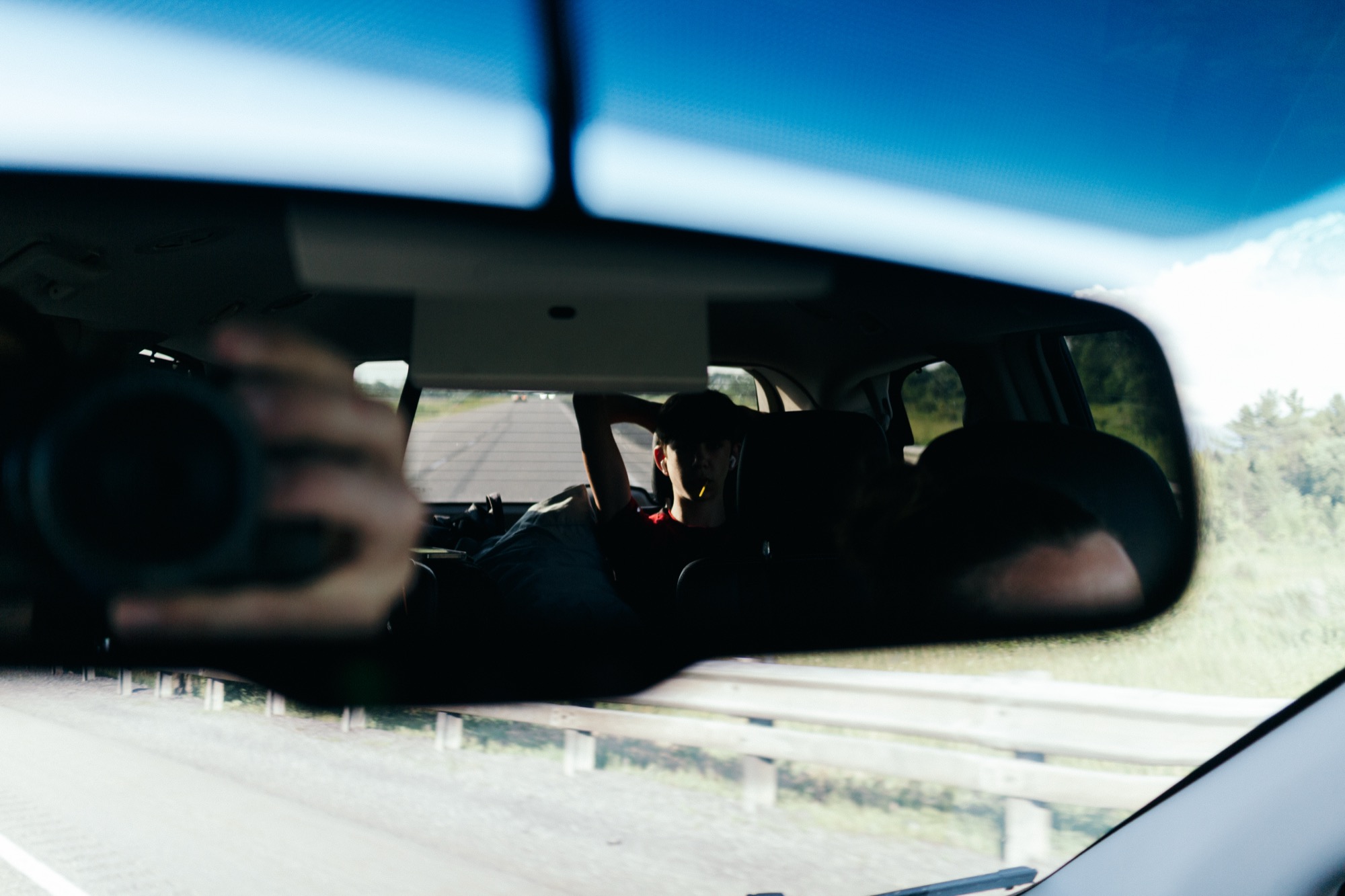
All of our summer vacations have lasted a week. Weekend to weekend, about 9-10 days max. This year, we tried something different: taking a two-week vacation out East.
We hit the road in late June for an epic road trip to the Atlantic Coast – first to Nova Scotia, Canada, for one week, then to Maine for the second week.
To get there, it meant driving 20 hours through Ontario, Quebec, New Brunswick, and finally Nova Scotia to our first cabin. We split the drive in half, staying overnight in Trois-Rivières, Quebec, at a lovely hotel on the St. Lawrence Seaway.
I took six years of French in high school and college, so it’s been a while since I spoke it fairly fluently. It was pretty humbling to walk into a gas station on the edge of Trois-Rivières where the checkout team spoke nothing but French.
Petrol, s’il vous plait?
Quebec was a brief stop on the way, but it is a huge Canadian province, and most of our driving ran along the St. Lawrence until we hopped over the river in Quebec City and then on through New Brunswick.
This is the first in a series of posts outlining our big summer adventure. I brought along the Canon EOS M6 with a full kit of EF-M lenses. I also kept the Canon EOS M in the car for road photos, and the few you see above in Trois-Rivières.
An epic road trip to the East Coast sporting the Canon M line. Lots more to come.
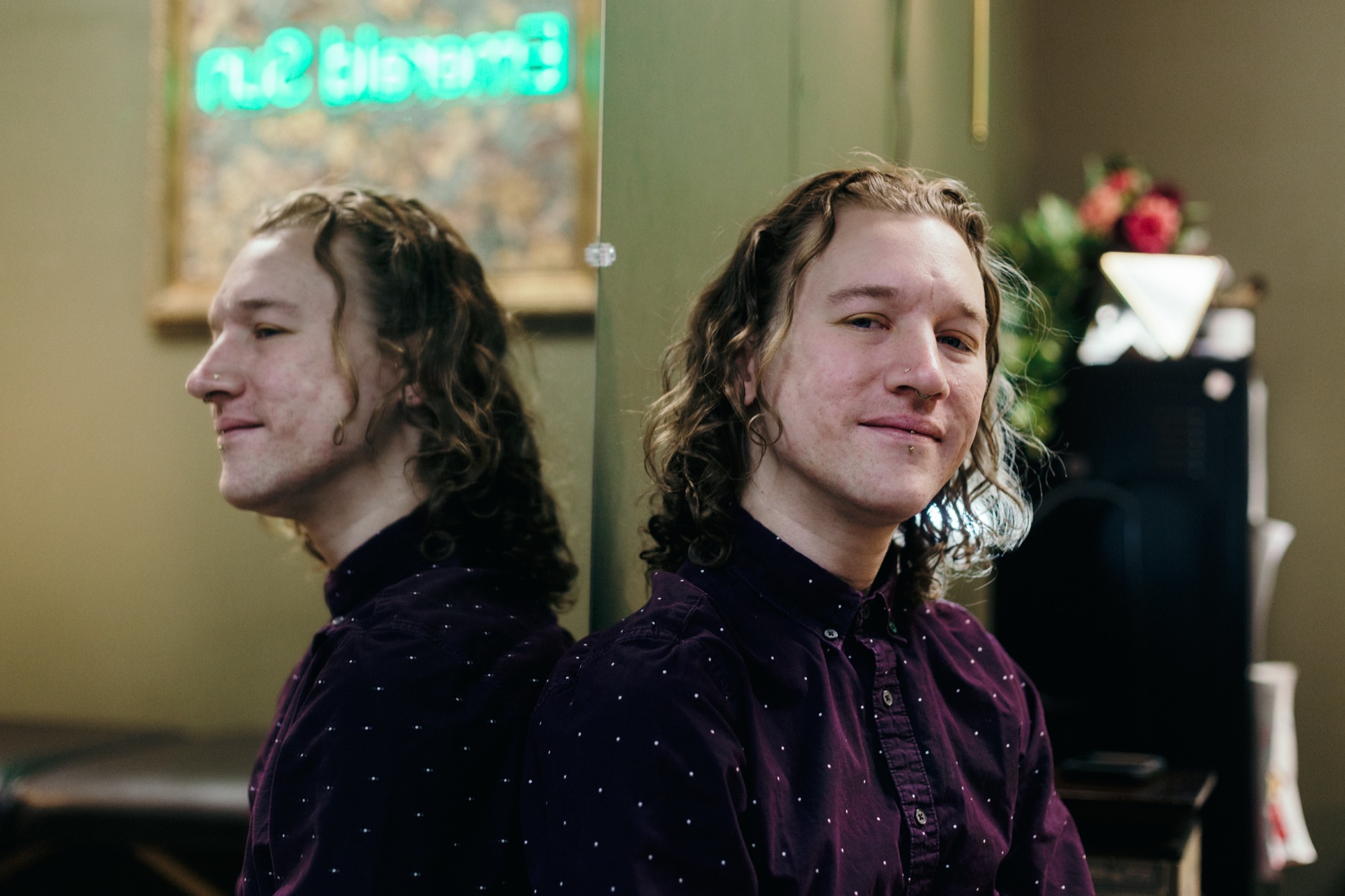
Inside the welcoming walls of 21 Blooms Tattoo Studio, Dylan Sodt (he/they) is quietly reshaping how people see themselves, one piercing at a time.
Dylan is a piercer, but that barely scratches the surface. For them, piercing is not just a form of body modification. It’s a practice of empowerment, trust, and transformation.
“I can build a little home with people in 30 minutes,” they say. “It creates a ritual environment. It’s an energetic exchange. They’re trusting me—and that’s when I think I have the best job.”
Born and raised in Jackson, Dylan’s path to piercing was anything but linear. He started by sketching the human figure as a kid and later found creative expression as a drummer in local bands. For much of his adult life, Dylan worked in restaurants, eventually managing the bar and kitchen at Sandhill Crane Vineyards. But even while building menus and leading teams, a deeper pull was growing.
“I hit a point where I needed something new,” he recalls.
Just two days after leaving the vineyards, he began a piercing apprenticeship.
“Piercing found me,” Dylan says.
Precision Meets Purpose
That leap of faith led them into a world where artistic intuition and technical precision are inseparable. Their practice is steeped in anatomy, geometry, and material science.
“It’s engineering on a smaller scale,” Dylan says.
Before he started working with Lauren Maureen of Emerald Sun Studios, Dylan had to start at the beginning: an apprenticeship.
Apprenticeship is the cornerstone of ethical piercing, and Dylan’s journey was a slow and deliberate one.
“You don’t even touch a needle for months. You learn the biology of wound healing, jewelry angles, and sterilization.”
But even more than technique, piercing is about people. Dylan specializes in body reclamation: helping those who have experienced trauma, abuse, or body dysmorphia reconnect with themselves.
“I want clients to feel more empowered when they leave here,” they say. “I’ve had clients squeal when they see themselves in the mirror. That sound? It means everything.”
Their work is artistic and deeply personal. Dylan observes each client closely: how they dress, carry themselves, the undertones of their skin, hair, and eye color.
“I have 30 minutes to clock your style,” he says. “It’s like painting on someone else’s canvas. Then it walks out the door and lives a whole life.”
From simple lobe studs to advanced curated ear setups, every piece is placed with aesthetic intention and precision measured in millimeters.
“We have to create the illusion of symmetry. If it’s off, people will feel it. Others will notice.”
Confidence, Care, and Ritual
Empowerment doesn’t come without responsibility. Dylan sees self-confidence as a professional obligation.
“You need a god complex to do this work—not arrogance, but self-respect,” they say. “You have to put clients at ease. There’s no room for shaky hands.”
They draw on Buddhist practices like breathwork and meditation to stay grounded and present, offering their clients not only a piercing, but also a moment of calm and clarity.
Outside the studio, Dylan finds creative joy in cooking—“an art form that doesn’t belong to me,” they say. “It’s all colors and flavors, and then it’s gone in 15 minutes.”
They surround themself with earth tones, thrifted treasures, and houseplants, always seeking to breathe new life into the old. That ethos flows directly into their work.
“What I do gives people a new image of themselves,” they say.
Community and Collaboration at 21 Blooms
At 21 Blooms, Dylan has found a creative home. The studio, owned by Emily Radke and envisioned as a hub for full-time piercers, is more than a workplace.
It’s a collaborative sanctuary.
“We push each other here,” Dylan says. “We talk through designs, hold critique nights. There’s a vulnerability in that, but it makes us all better.”
For them, the studio is also a commitment to raising the standard in Jackson.
“This city deserves a proper piercing space. If you get pierced by me, I consider you a client forever. I’m an island of proper piercing.”
Looking ahead, Dylan is pursuing certification with the Association of Professional Piercers (APP), a national standard of excellence in the field.
“There’s no ceiling in this work. You can always get better,” they say.
From the restaurant floor to the piercing chair, and no matter their tools, Dylan has always been in the business of care.
“I’m in service of an idea,” they say. “That people can see themselves differently. That they can walk out of here and feel like they belong to themselves again.”
I’m not here to sell anyone on getting a day job, and I am plenty conscious that day jobs aren’t necessarily easy to come by right now. But there’s definitely something liberating about not relying on your art to pay the rent.
My decision to hold onto a steady job while building a creative life is a structure that lets me do both things well (most of the time). It honors my creativity and my sanity.
Twenty years ago, on my first big road adventure across America on Route 66, I noticed something when I got back:
As soon as I took the highway exit to get back into my hometown, I was disappointed. “Back to reality,” I thought. It’s dramatic to say out loud, but getting back home left me with the feeling that the trip was all make-believe. It was like I never left.
That feeling, that disappointment, has never gone away. In fact, just this summer, when we returned from the Atlantic coast, it felt the exact same way taking that exact same exit off the highway.
I’m not saying we didn’t have a wonderful time, nor am I saying it would’ve been better if we never left. I am saying that coming back home to all the to-do lists, work, and obligations can be a bummer.
It feels so good to travel, to see new places and experience new things. And then you drive away, leaving it all behind with photos and memories to keep you going until the next big adventure. Luckily, we have our fair share of future travel plans.
Real life feels like the in-between moments before the next getaway.
That’s why I advocate for taking little adventures along the way – taking a day and going hiking, say, or driving to a new small town and making pictures there.
Whatever helps until the next escapade.
Shot on the Canon EOS M6 and EF-M 22mm f/2 in Brooklin, Maine.
Do you know that thing with film cameras where it may take you weeks, months, or even years to shoot a whole roll of film?
And then you get the film photo printed, and it’s like rediscovering everything you photographed over that time period?
I do that on my digital cameras, too. I have my front-seat camera, the Canon EOS M, and my around-the-house camera, the Canon 5D. Sometimes, I’ll go weeks without importing the photos into Lightroom. There’s no rush, so I let the images collect on the card.
That time and distance help me evaluate whether I like the pictures or not. So does forgetting about photos in my Lightroom catalog. I can go years without looking at some photos, and then I look through my catalog and remember moments, scenes, trips, and light.
The trick is to actually look back at your archive and see what’s buried there.
I can not stress how important it is not to let the pressure of posting a photo only to have no one pay it any attention stop you from enjoying what you do. You can jump from service to service all you want but the only thing that will change the reactions you get is your own personal development and reputation as a photographer which, like anything, takes time and patience. Heres a little secret, the grass is more or less the same shade of green no matter where you go.
We managed to get away for our 10-year wedding anniversary.
It was chilly for the last weekend in May, but we returned to two of our favorite spots near the Lake Michigan coast: Virtue Cider in Fennville, Michigan, and The Kirby Hotel in Douglas, Michigan.
Virtue Cider
Virtue was one of my early “holy crap” ciders, where I took a chance on a six-pack of cans and was blown away.
Now we come back to taste the new ciders, grab a snack, and head outside for some acoustic guitar.
Kirby Hotel
We came to the Kirby on the coldest day of 2022, after the wassail celebration at Virtue Cider was cancelled because of the weather.
It was fine by us, because that winter, we had the place almost to ourselves and we got to chat with the chef and operator about their historic hotel.
This time, the house was packed for dinner, and we had several guests in the hotel. But the next morning, for breakfast? Just us and the chef again.
I love finding little places like this, where you become a regular and get to know the staff.
Shot on the Canon M6 and EF-M 22mm and 32mm lenses.
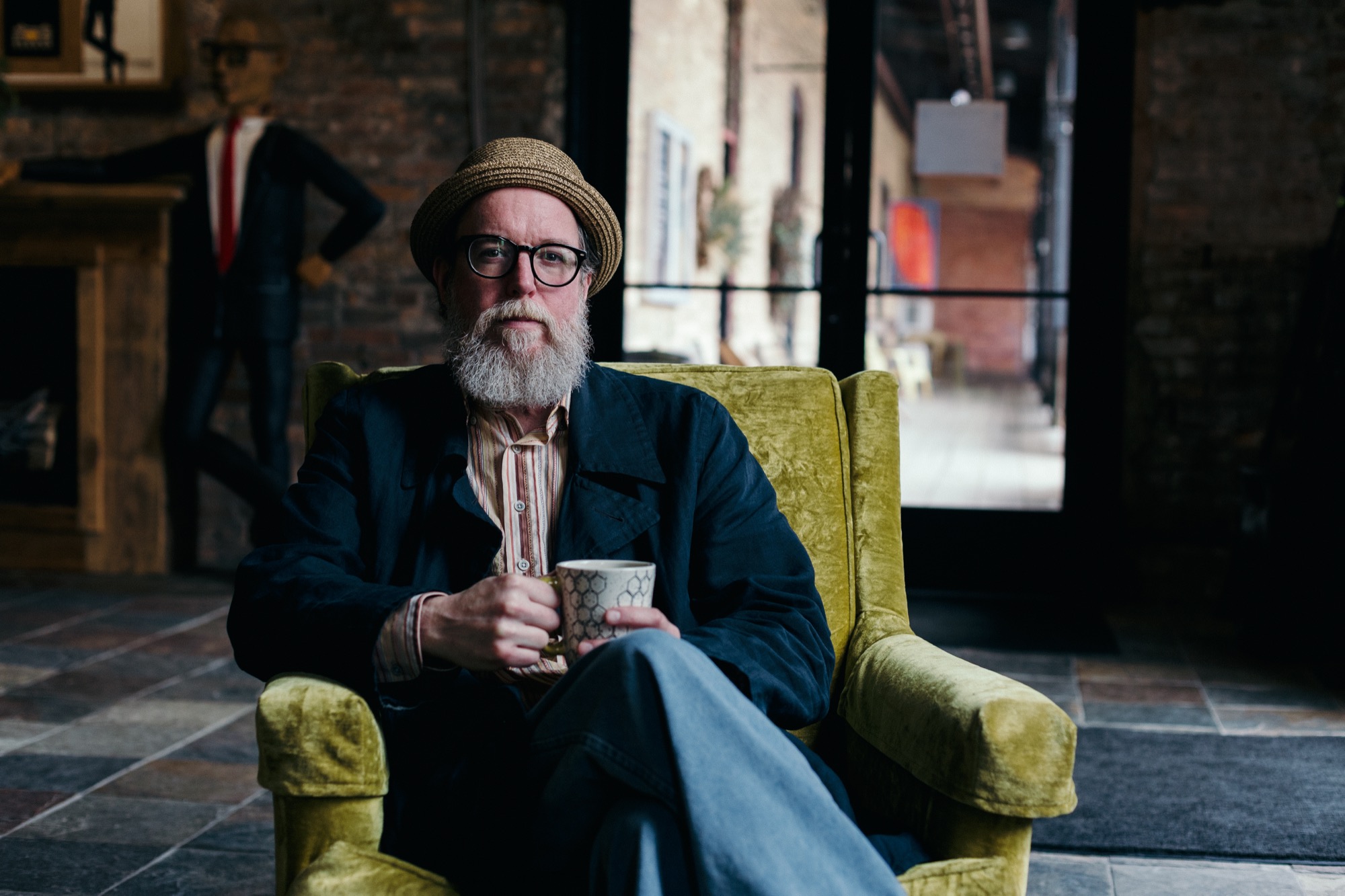
Tucked in a cozy corner of Art 634 in Jackson, Michigan, Jason Heinrich’s Yesterdream Studio is a storefront and a portal to comfort, creativity, and memory.
Admittedly, the space defies easy classification.
“It’s not really a furniture store, not really a record store, not really a gift shop,” Jason says with a laugh. “But it’s also all of those things.”
Growing up in a Downriver factory town in the 1980s, Jason was surrounded by the aesthetic leftovers of previous decades: glass lamps, mid-century furniture, and the sound of rock and roll.
“Especially in finished basements and cottages, there was always that old stuff from the ’60s and ’70s. It was everywhere,” he says. “That became my comfort. I didn’t know it then, but I’ve always been chasing that feeling.”
At Yesterdream Studio, Jason’s goal is to bring back that sense of comfort. Everything in the space invites visitors to slow down, remember, and then use the items in the shop to make their own space comfortable.
“Transforming your space can transform your mental health,” Jason says. “If you’re surrounded by things that bring you comfort, it affects your mood. That’s a big part of why I do this.”
Finding His Way to Jackson
Jason’s journey here hasn’t followed a straight line. After starting out in fine arts, he spent several years as a laborer in the plumbing trades, his family’s profession stretching back generations. Later, he earned a certificate in graphic design and worked in marketing roles for various Michigan associations. That work included working as a graphic designer and social media manager for marketing departments
But every time he stepped away from art, something pulled him back.
“I’ve tried to reinvent myself so many times,” he says. “But creativity always finds its way back in. I don’t go looking for creative work. It just kind of finds me.”
He opened Yesterdream Studio in 2023 at Art 634, after years of collecting, designing, and repurposing, while continuing to work on freelance graphic design and marketing projects.
Jason says his work revolves around sustainability.
“One of the biggest parts of this place is to reimagine, repurpose, and reuse,” Jason says. “There’s no reason to buy brand-new when you can take something old, paint it funky colors, and give it new life. And it’s better for the environment.”
His love for natural patinas and vintage design finds its way into the usefulness and beauty of everyday objects. For an example, Jason points to a large metal tackle box on his shelf.
“People throw stuff away because they don’t see the value. But to me, this tackle box is beautifully designed. It could be anything – a painter’s box, a face painter’s kit, whatever,” he says. “That’s what I love about it.”
Everything Old Is New
Jason’s love of vintage also extends to running a local steampunk convention.
His journey from Renaissance fairs to Steampunk festivals began in the early 2000s. After discovering Steampunk in 2011, he launched monthly events and co-created the Gears, Beards, & Beers competition. Partnering with DJ Van Helsteam, they later hosted the Monster Hunter Bash.
When Michigan’s Steampunk scene slowed during the pandemic, Jason found new inspiration at Art 634. In 2023, he launched Steampunk on the Bricks, a one-day festival that blends workshops, live performances, and integrated vendor experiences. Now in its second year, the event draws hundreds from across the Midwest thanks to support from Art 634, Experience Jackson, and Manchester Underground.
AN Antidote to Intensity
Jason is productive, often jumping from project to project – painting, cooking, woodworking – and he rarely sits still for too long.
“It’s kind of like checking things off a list,” he says. “One minute, I’m carving a walking stick, and the next, I’m painting a side table. It’s all over the place, but it works for me.”
Above all, Jason wants Yesterdream Studio to provide an antidote to the intensity of modern life.
“The world’s gotten meaner,” he says. “People are stressed out, trying to survive. We’ve lost compassion and grace. I wanted to build a space that reminds people to slow down, to breathe.”
His space also invites other artists, including his colleagues from Art 634, to collaborate and network, helping create a productive, inspiring space for Jason to dabble and create.
“I just want to be around authenticity,” he says. “No personas, no fakeness. Just real people being real. That’s what this space is about.”
In my latest YouTube video, I test out several film-like Canon Picture Styles to see which of them can give Canon photographers that Fujifilm-like simulation experience.
Preslav Rachev left a comment asking for feedback on a Picture Style he recently developed, Cinematic Color Negative, and offered it up for a free trial.
Last weekend, I loaded up Preslav’s filmic emulation onto my Canon M6 and shot for an artist friend of mine at his Steampunk on the Bricks event here in Jackson, Michigan.
Overall? It’s good. I like the colors and contrast – it fits my style of shooting nicely.
The reds pop, and the greens are muted. That’s just what I’m looking for in my Canon film simulations. And in good lighting, skin tones are natural.
However, testing it out on our new baby niece, and in mixed lighting, the skin tones were a bit overpowering:
Everyone else’s skin tones looked okay, but poor Baby Iris. She got the neon orange treatment. It could be a combination of jaundice and a reddish skin hue.
The baby is an outlier. For the most part, Preslav’s Cinematic Color Negative Picture Style worked well over a weekend of shooting.
A few more RAW vs JPG shots for comparison (RAW is on the left):
My eye notes the subtle desaturation of the greens and blues. The top comparison makes that clear with the plants and the blue sky.
The bottom comparison is a little more subtle: contrast is up, and the house appears whiter in the JPG. Again, the sky in the back loses a bit of blue. Whites are whiter, blacks are blacker – both help increase the contrast.
Head to Gumroad, throw Preslav a buck or two, and try out Cinematic Color Negative yourself (and check out his photography too).
Here on Wildwood Ave and Edward St, behind the public high school, you can sense the age in the size of the homes and their proximity to downtown Jackson.
It’s quiet. A little under construction. And here on a sunny day in early May, there’s plenty to see.
It’s tough for me to make photos in cloudy conditions. I rely on sharp, dramatic sunlight for much of my work.
But here, on the northwest side of Jackson, Michigan, I gave it a good go around the Hibbard and Hallett Street neighborhood.
Instead of capturing light, I did my best to capture interesting settings, objects, or colors. If nothing else, it’s good for me to exercise the non-contrasty photography muscles.
Photos and videos are increasingly used for informational reasons rather than just for pure aesthetic and artistic purposes…Everyone is advertising everything. The idea of getting people to see, engage, and appreciate your still images feels so quaint in 2025.
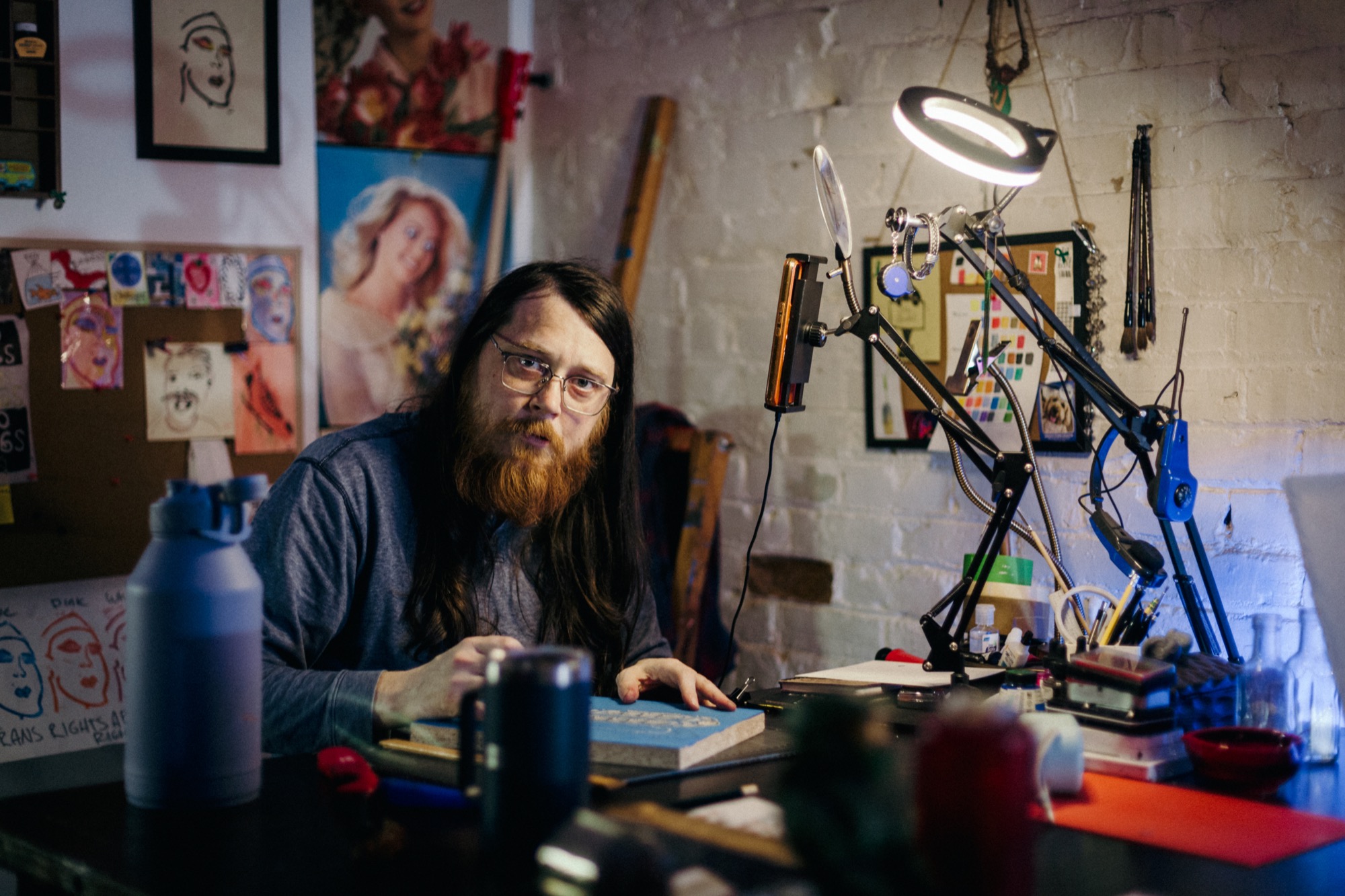
Creativity and transformation define Logan Swoffer’s artistic journey.
As both a musician and printmaker, his artistic evolution is deeply tied to his lived experiences that were shaped by hardship, discovery, and ultimately, a second chance at life.
His near-death experience in 2023 profoundly changed his perspective, instilling a newfound appreciation for beauty and a drive to create.
Finding His Path
Logan was born in Jackson, Michigan, but his journey took an early turn when he moved to Arizona with his mother and stepfather in the fifth grade.
Settling in Deer Creek near Flagstaff, he discovered his passion for music at 14, picking up the guitar and finding that creativity “flipped on like a light switch.” He also dabbled in graffiti and doodling, though his artistic pursuits remained mostly informal at the time.
In 2005, after high school, Logan began traveling back and forth between Arizona and Michigan. Eventually, he and his mother left Arizona for good, escaping a difficult situation with his stepfather. He reconnected with his biological father, a poet and printmaker, and the more time they spent together, the more Logan saw their similarities.
“He was a scoundrel, so I come by that naturally,” he jokes.
His father’s work in printmaking would later become a major influence on Logan’s artistic career.
During this period, Logan became immersed in the local Jackson music scene while working various jobs, including a long stint in medical billing. Music remained a core part of his identity, but his artistic journey had yet to fully take shape.
A Life-Changing Liver Transplant
Years of heavy drinking caught up with Logan in 2023 when he fell critically ill.
At the time, he was working at Unleashed and Loving It when he began experiencing aches and fatigue. Friends and coworkers noticed his declining health, but it wasn’t until his mother intervened that he finally sought medical help.
Doctors diagnosed him with hepatic encephalopathy, a life-threatening condition caused by liver failure. Days away from death, Logan was rushed to Detroit for a liver transplant in May 2023.
Reflecting on this experience, he describes it as a complete transformation.
”I didn’t do a 180; I vanished and came back a different person,” Logan says. “One week you’re going to die, then you go to sleep and wake up a changed person. It’s a beautiful thing.”
His recovery was swift, but the experience left a profound impact on his outlook. Now immunocompromised and managing ongoing health risks, Logan embraces his “new normal” with gratitude and determination.
A New Artistic Purpose
Following his transplant, Logan found himself drawn to beauty in a way he never had before. Seeing an Instagram post about printmaking ignited a deep passion within him.
“It lit me up like a firecracker,” he says.
Though he had never considered himself a visual artist, he quickly embraced the medium, exploring printmaking, watercolor, and mixed media.
“Maybe I got a bit of my liver donor’s soul, but something changed,” Logan says. “I saw things I didn’t use to see.”
His art often blends delicate floral imagery with bold political statements, advocating for trans rights and marginalized communities.
“Print is the perfect vessel. I can put it up wherever I want. Say what I want. The pointedness is out of necessity,” he says.
While he strives to balance political messages with beauty, he acknowledges that art is a powerful tool for activism.
Sobriety and Moving Forward
Logan’s sobriety is deeply tied to his gratitude for the second chance he’s been given.
“I do it out of respect for my donor, who died and gifted me with this new lease on life,” he says.
He has since built a strong community of sober friends who support one another in their shared commitment to a healthier lifestyle. Since January 2024, Logan has been working out of Art 634, where he’s found another supportive and inspiring community.
“You could make art anywhere, but going to a creative space? I just love it here,” he says.
He hopes to contribute to Jackson’s cultural revival by expanding his reach through zines, exhibitions, and collaborative projects.
Looking ahead, Logan remains focused on growing his artistic presence.
“I could’ve gotten into archery or race cars, but I saw that printmaking video, and that’s what stuck,” he says.
Through music and printmaking, Logan channels his gratitude, using art as both a personal outlet and a means to inspire others.
To be around musicians as they make music? Try new things? Rehearse new songs?
It really is the best thing.
My wife’s band, the Harmony Gardeners, is working on original songs for their summer concert series and a new album. It was fun to grab some rehearsal photos with them in the studio.
When I worked close to an urban center – Ann Arbor and Albion, Michigan, for instance – exploring neighborhoods was a good way to get out, take a walk, and make photos of what I saw. I do it around my own neighborhood, too.
This style of photography reminds me of something William Eggleston would capture: the everyday life of an American town.
Lately, I’m making my way around local neighborhoods I don’t know well. This one, by the city’s primary high school, took me on streets I’ve never seen. I woke up early on a spring morning and took a walk to see what I could see.
Neighborhoods, with good light, are a constant source of good material. I could do this forever.
I purchased my Canon EOS M 12 years ago during a Canon fire sale. Very quickly, I appreciated the M’s size, portability, and image quality.
As the years went on, the M was always there. It went everywhere: to the beach, on family trips, on urbex adventures, and in my front seat as I drove around Michigan grabbing anything that caught my eye. The M is still my grab-and-go kit, my reliable everyday carry camera.
Last year, I tried to replace it – first with the M200 and then the M6. But like a comfy, broken-in pair of shoes, I kept the original M out of – what – loyalty? Insecurity?
I’m glad I did, because on my recent Detroit trip, my Canon M6’s shutter button started to malfunction. Then, in a terribly frustrating mishap, I dropped my M6 and the EF-M 22mm on a sidewalk, denting the lens and leaving scuff marks on the M6. I’ll have to replace the lens, which is expected. The drop was my fault. But the M6’s shutter button? It’s a known issue and it hit me at the most inconvenient time while we’re on vacation. Despite my attempts to fix it, the problem is still there, and repairing it will cost more than what the camera is worth.
I tried replacing the OG Canon M. Twice now. But the hits keep on hitting.
The first week I owned the M, back in 2013, I dropped it on a street. I was so mad at myself. Here was this brand-new camera, and I had already tried to wreck it.
Do you know what happened? Nothing. The M has consistently kept shooting ever since. Despite all the drops, all the bangs, all the dust and sand, it just keeps going. In 2013, I wrote:
The camera itself is a solidly-built little instrument. It feels dense, but not heavy, so that it feels like a good, quality hunk of camera.
Here we are, 12 years later, and that sentence is still true. No, the dial pad won’t let you go up in selections anymore, and yes, it flakes out now and again. But I’ll take manageable reliability over a complete lack of functionality during critical times.
I grew to love the M6, too. I love the look, the convenient dials, and the grip. But if the shutter button gives me problems, that becomes a core issue with the camera’s operation.
Luckily, I kept the M. It’s still my everyday carry, it still travels in my vehicle front seat, and it’s still there when I need it. I could replace it with a new-in-box model, and it would probably last me another 12 years. Apart from my Canon 5D mark 1, it’s my favorite camera of all time. I talk lovingly about it in ways film photographers talk about the Leica M2 or M3, or Nikon users talk about the F series.
Canon’s M series is a dead system. I still love it.
I’m not sure where to go from here. But whichever way I go, the Canon M remains by my side.
All images captured on the Canon EOS M and EF-M 22mm f/2.